What's the Real Difference Between API Wrappers and Native Models?
The api wrapper vs native debate comes down to a simple question: do you want to rent AI capabilities or own them?
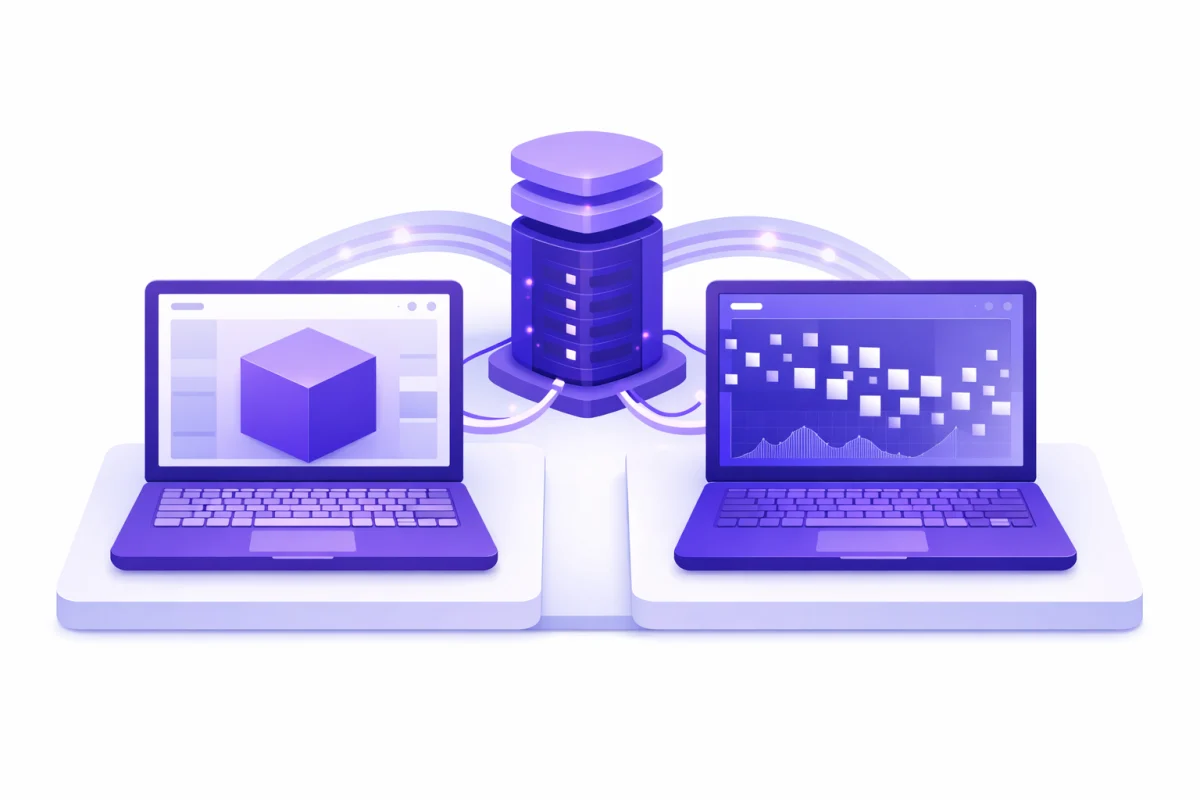
An API wrapper means you're calling someone else's model through their infrastructure. You send a request to OpenAI, Anthropic, or Google, they process it on their hardware, and you get a response back. The model never touches your servers.
A native model (or self-hosted LLM) means you're running the actual model on infrastructure you control. That could be on-premises servers, cloud instances you manage, or even edge devices. The model weights live on your hardware, and inference happens locally.
Both approaches have legitimate use cases. The problem is that too many teams pick one without understanding the tradeoffs.
Why This Decision Matters More Than Ever
In 2026, the landscape looks different than it did two years ago.
API prices have dropped dramatically. DeepSeek pushed costs down by 90% compared to early GPT-4 pricing. OpenAI's GPT-4.1 now offers 1 million token context windows at prices that would have seemed impossible in 2024.
But at the same time, self-hosting has become more accessible. Open-source models like Llama 3 and Mistral now rival proprietary options for many tasks. Quantization techniques let you run 7B parameter models on consumer GPUs. Tools like Ollama and LM Studio make local deployment almost trivially easy.
So the calculation has changed. It's no longer "cloud because you have no other choice." It's "which approach actually fits your specific situation?"
Understanding how AI model providers compare is essential before making this decision.
The Case for API Wrappers: Managed AI APIs
Speed to Market
If you need something working this week, managed AI APIs win. You get an API key, write a few lines of code, and you're calling state-of-the-art models. No infrastructure provisioning. No model deployment. No MLOps expertise required.
For startups testing product-market fit, this speed matters enormously. You can validate whether users want your AI-powered feature before investing months in infrastructure.
Zero Maintenance
OpenAI handles the GPU clusters. Anthropic manages the model updates. You don't wake up at 3am because inference servers crashed.
This isn't a small consideration. Running production LLM infrastructure requires specialized skills. GPU optimization, model serving, scaling inference, handling rate limiting. These are full-time jobs. For teams without dedicated ML infrastructure engineers, managed APIs are the only realistic option.
Access to Frontier Capabilities
The most advanced models remain proprietary. GPT-4.5, Claude Opus, and Gemini 2.5 Ultra aren't available for self-hosting. If your use case genuinely requires frontier capabilities, you're using APIs whether you like it or not.
Understanding foundation vs frontier AI models helps clarify when you actually need cutting-edge vs when a smaller model suffices.
Predictable Per-Token Costs (At Low Volume)
When you're processing a few thousand requests per day, pay-per-token pricing is actually quite reasonable. You pay exactly for what you use. No idle costs. No capacity planning headaches.
The math changes at scale, which we'll get to. But for early-stage products, API pricing often makes more financial sense than the fixed costs of self-hosting.
The Case for Native Models: Self-Hosted LLMs
Data Privacy and Compliance
This is often the deciding factor for enterprises.
When you use an API, your data leaves your network. Even with enterprise agreements and SOC 2 compliance, sensitive information travels to third-party servers. For healthcare (HIPAA), finance (SOC 2, FINRA), legal, and government applications, this is frequently unacceptable.
Self-hosted LLMs keep everything on-premises. Prompts never leave your infrastructure. You maintain complete audit trails. Compliance becomes dramatically simpler.
Cost Efficiency at Scale
Here's where the openai api vs local math gets interesting.
API pricing looks cheap until you're processing millions of tokens daily. At that point, the economics flip. A self-hosted setup with a few A100 GPUs can process more tokens at lower cost than equivalent API spend.
One analysis found that organizations processing millions of requests monthly can save 40 to 60% by migrating from GPT APIs to hosted open-source models like Mistral or Mixtral.
But there's a catch. Self-hosting has substantial upfront costs. GPUs, storage, engineering time, ongoing maintenance. A minimal internal deployment easily runs $125,000 to $190,000 per year. High-end setups can cost over $70,000 per month just for infrastructure.
So the break-even point depends heavily on your volume and your team's capabilities.
Customization and Fine-Tuning
API providers offer some customization, but it's limited. You can't fundamentally change how their models behave.
Self-hosting lets you fine-tune on proprietary data. You can train the model to understand your domain's jargon, your organization's workflows, your specific output formats.
For applications where generic LLM outputs fall short, this customization creates genuine differentiation. You're not just wrapping someone else's model. You're building something competitors can't easily replicate.
No Rate Limits or Quotas
API providers impose rate limits. During high-traffic periods, you might hit quota restrictions precisely when you need capacity most.
Self-hosted infrastructure means you control the capacity. No rate_limit_exceeded errors during your product launch. No waiting for quota increases when demand spikes. For a deeper look at these limitations, see our guide on understanding API rate limits.
Latency Control
API calls involve network round trips. Even with fast internet, you're adding 100 to 300ms just for data transit. In some regions, latency can hit 800ms or more.
Local inference eliminates this entirely. For real-time applications like code completion, voice assistants, or interactive AI, the latency difference is noticeable and often critical.
The on-device vs cloud AI tradeoffs become especially important for edge deployment scenarios.
The Hosted vs Self-Hosted LLM Decision Framework
Rather than picking sides ideologically, use these questions to determine the right approach for your specific situation.
Question 1: How Sensitive Is Your Data?
If you're handling protected health information, financial records, legal documents, or classified data, self-hosting is likely required. The compliance overhead of using external APIs often exceeds the infrastructure cost of running your own models.
For consumer applications with less sensitive data, API wrappers are typically fine.
Question 2: What's Your Expected Volume?
Low volume (under 100,000 tokens/day): APIs are almost always more cost-effective. The fixed costs of self-hosting don't make sense at this scale.
Medium volume (100,000 to 10 million tokens/day): This is the gray zone. Run the numbers for your specific use case. Factor in engineering costs, not just infrastructure.
High volume (over 10 million tokens/day): Self-hosting typically wins on cost. The savings justify the infrastructure investment and ongoing maintenance.
Question 3: Do You Have the Team?
Self-hosting requires ML infrastructure expertise. GPU optimization, model serving frameworks, monitoring, scaling. If you don't have these skills in-house, you'll need to hire them or work with contractors.
For teams without this expertise, the hidden costs of self-hosting often exceed the apparent savings. You're not just paying for GPUs. You're paying for the people who know how to run them.
Question 4: How Critical Is Latency?
If sub-100ms response times are essential, self-hosting or edge deployment is the only realistic path.
If 300 to 500ms is acceptable, APIs work fine for most applications.
Question 5: Do You Need Frontier Capabilities?
If your application genuinely requires GPT-4.5 level reasoning or Claude Opus quality, you're using APIs. Open-source alternatives are good, but they're not yet at the frontier.
If a 7B or 70B parameter open-source model handles your task adequately, self-hosting becomes viable.
The Hybrid Approach: Why Most Winners Combine Both
Here's what experienced teams actually do: they use both approaches strategically.
Start with APIs for prototyping. Validate your concept quickly. Don't spend months on infrastructure before you know users want your product.
Move to self-hosting for proven workloads. Once you have predictable, high-volume use cases, migrate those specific functions to self-hosted models.
Keep APIs for general-purpose queries. Not everything needs to be self-hosted. Low-volume, general-purpose tasks can stay on APIs indefinitely.
Use self-hosting for sensitive data paths. Customer documents, private communications, compliance-critical operations run on your infrastructure. General chat features can use external APIs.
This hybrid architecture gives you flexibility without betting everything on one approach.
For teams deploying AI to production, this staged migration often provides the best balance of speed and control.
Direct Model Access: Beyond the Binary Choice
The api wrapper vs native framing misses a middle ground: hosted open-source models.
Services like Together AI, Fireworks AI, and Groq run open-source models (Llama, Mistral, Mixtral) on their infrastructure, exposing them via API. You get the convenience of API access with models you could theoretically self-host later.
This approach offers several advantages:
- Lower costs than proprietary APIs. Open-source models on hosted infrastructure typically cost 50 to 80% less than equivalent proprietary options.
- Migration path to self-hosting. If you later decide to self-host, you're already using compatible models.
- No vendor lock-in. You're not dependent on any single provider's proprietary model.
For many teams, this middle path makes more sense than either extreme.
When configuring these services, understanding complete LLM parameters helps you optimize performance and cost.
Building AI Wrapper Products: Is It Still Viable?
The "GPT wrapper" criticism has become a cliche. But is it valid?
The reality is nuanced. Yes, a thin UI layer over ChatGPT with no differentiation is easily replicated. But that's not the only way to build on top of LLM APIs.
Successful AI wrapper products differentiate through:
Workflow integration. Cursor isn't just calling GPT. It's deeply integrated into the coding workflow, editing files directly, maintaining context across your codebase.
Domain expertise. Legal AI tools understand contract structures. Healthcare AI tools handle medical terminology. This domain knowledge creates value APIs alone can't provide.
Proprietary data. Companies building on their own data moats create differentiation that competitors can't simply replicate with the same API access.
Distribution and user experience. Many winning products have identical underlying tech to competitors. They win on distribution, brand, and user experience.
The question isn't "is this a wrapper?" The question is "does this solve a problem people will pay for?"
For those exploring this path, our deep dive on building AI wrapper products covers strategies that work.
Creating Competitive Moats With Your AI Stack
Whether you choose APIs, self-hosting, or a hybrid approach, the deployment decision is just one factor in building a defensible business.
The strongest AI companies combine multiple moats:
Data moats. Proprietary datasets that improve your model's performance in ways competitors can't match.
Workflow integration. Deep embedding into user workflows that creates switching costs.
Network effects. Products that get better as more people use them.
Domain expertise. Understanding of specific verticals that generic AI tools can't replicate.
Your infrastructure choice should support these broader moats, not substitute for them.
Learn more about creating competitive AI moats that transcend your underlying model choice.
Practical Implementation Considerations
For API Wrapper Implementations
Handle streaming properly. Users expect real-time token streaming for chat interfaces. Implement streaming API responses correctly from the start.
Batch when possible. If your workload allows, batch processing API requests can reduce costs by 50% or more through batch API endpoints.
Implement caching. Many prompts repeat. Caching common queries dramatically reduces API costs without sacrificing user experience.
Plan for rate limits. Build retry logic and fallback providers into your architecture from day one.
For Self-Hosted Deployments
Start with quantized models. 4-bit quantization lets you run larger models on smaller hardware with minimal quality loss.
Consider model distillation. Smaller models trained to mimic larger ones can provide 90 to 95% of the capability at a fraction of the computational cost.
Use specialized serving frameworks. vLLM, TensorRT-LLM, and similar frameworks dramatically improve inference throughput compared to naive implementations.
Monitor everything. Self-hosted deployments need proper observability. Latency metrics, throughput, error rates, GPU utilization.
Open Weights vs Open Source: A Key Distinction
When evaluating self-hosting options, understand the difference between open weights vs open source models.
Open weights means the trained model parameters are available for download and use. You can run inference, potentially fine-tune, and deploy commercially (license permitting).
Open source in the traditional sense means the full training code, data, and methodology are available. You could reproduce the model from scratch.
Most "open" models today are open weights, not truly open source. This matters for understanding what you can actually do with them and what risks you're taking.
The No-Code Alternative
Not everyone building AI products needs to write code.
No-code AI agent builders let non-technical users create sophisticated AI workflows without programming. These tools typically use managed APIs under the hood, but abstract away the implementation details.
For business users, marketing teams, or small companies without engineering resources, no-code platforms offer a legitimate path to AI-powered products. The tradeoff is less customization and control compared to code-based implementations.
Making Your Decision
There's no universally correct answer to the api wrapper vs native question. The right choice depends on your specific circumstances.
Choose managed APIs when:
- You're prototyping or validating early concepts
- Volume is low to moderate
- Data sensitivity is low
- You lack ML infrastructure expertise
- Speed to market is critical
- You need frontier model capabilities
Choose self-hosted when:
- Data privacy or compliance requirements are strict
- Volume is consistently high
- Latency requirements are demanding
- You have (or can hire) ML infrastructure expertise
- You need deep customization or fine-tuning
- Long-term cost optimization is important
Choose hybrid when:
- Different workloads have different requirements
- You want flexibility to evolve your architecture
- You're scaling from prototype to production
- You want to avoid vendor lock-in while maintaining convenience
The infrastructure choice matters, but it's not the whole story. Ultimately, what matters is whether you're building something users genuinely need. The best infrastructure in the world won't save a product nobody wants.