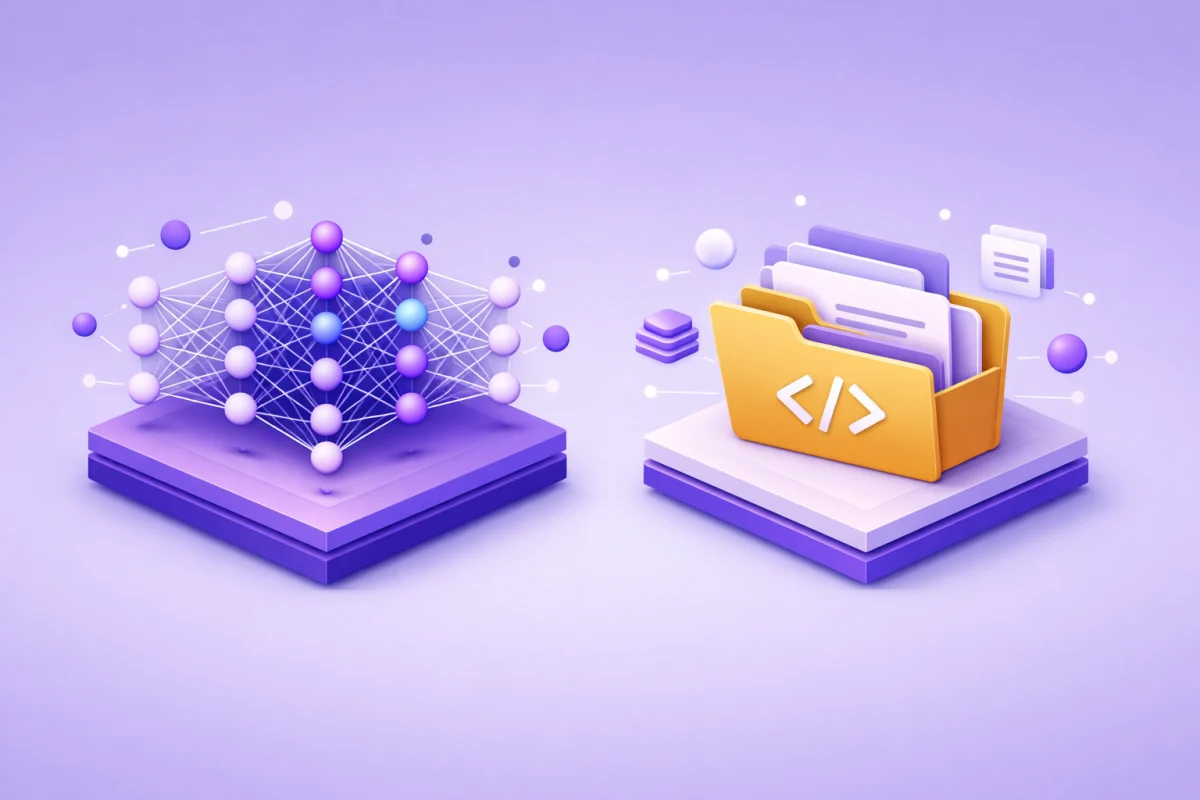
Open weights vs open source sounds like the same thing. It's not.
This distinction has sparked industry battles, prompted official definitions, and confused countless developers trying to figure out what they're actually allowed to do with models like Llama, DeepSeek, and Mistral. If you're building with large language models, understanding what "open" actually means will save you from licensing headaches and help you choose the right model for your project.
Here's the short version: open weights gives you the finished product. Open source gives you the recipe, the ingredients list, and the kitchen setup.
Let's break down what that actually means in practice.
What Does "Open Weights" Mean?
The open weights meaning is simpler than you might think. When a company releases an AI model with open weights, they're sharing the trained parameters (weights and biases) that make the model work.
These numerical values are what the model "learned" during training. They determine how the model processes inputs and generates outputs. With open weights, you can download these parameters and run the model on your own hardware.
What open weights typically includes:
- Model weights (the trained parameters)
- Basic inference code (to run the model)
- Model architecture documentation
- Sometimes fine-tuning examples
What open weights usually doesn't include:
- Training code (how they actually trained the model)
- Training data (what they trained on)
- Data processing pipelines
- Intermediate checkpoints
- Full evaluation methodology
Think of it like buying a car versus getting the factory blueprints. You can drive the car anywhere, customize it, and even tune it up. But you can't rebuild the car from scratch because you don't know how the engine was originally manufactured.
This is exactly how Llama open weights works. Meta releases the trained model parameters under their Community License. Developers can download Llama 4 Scout or Maverick, run them locally, and fine-tune them for specific tasks. But Meta doesn't share the training data or the complete training pipeline.
What Makes AI Truly Open Source?
Open source AI models require significantly more transparency.
In October 2024, the Open Source Initiative (OSI) released their official Open Source AI Definition after two years of debate with tech companies, researchers, and advocates. According to OSI, a truly open source LLM must provide:
1. Data Information
Detailed information about training data so someone could recreate a "substantially equivalent system." This includes data sources, processing methods, filtering techniques, and how to obtain or license the data.
2. Complete Code
The full source code for training and running the model, including data processing scripts, training configurations, validation code, and architecture details.
3. Model Parameters
Weights and checkpoints released under OSI-approved terms, allowing modification and redistribution.
4. Four Freedoms
Users must be able to use the system for any purpose, study how it works, modify it, and share it freely.
The definition specifically addresses the training data question that makes AI different from traditional software. You can't truly understand or reproduce an LLM without knowing what it learned from.
This is where most "open" models fall short. They release weights but keep their training data secret, citing competitive advantage or legal concerns about copyrighted content in their datasets.
How Is Llama Open Weights but Not Open Source?
Meta's Llama models perfectly illustrate the open weights vs open source divide.
Llama 4, released in April 2025 with its Scout and Maverick variants, is marketed with phrases like "in keeping with our commitment to open source." Mark Zuckerberg has called Llama models "open source" in public announcements. But by OSI's definition, they're not.
Why Llama fails the open source test:
First, Meta doesn't release training data or detailed information about what Llama learned from. We know Llama 4 was trained on over 30 trillion tokens including web content, code, and Meta-proprietary data from Facebook and Instagram. But there's no way to inspect or reproduce this dataset.
Second, the Llama Community License includes restrictions. Companies with over 700 million monthly active users must request a special license. The Acceptable Use Policy prohibits certain applications. These field-of-use restrictions violate the OSI's requirement for unrestricted freedom to use.
Third, the Free Software Foundation classified Llama 3.1's license as "nonfree software" in January 2025, specifically criticizing its acceptable use policy and enforcement of restrictions outside the user's jurisdiction.
The OSI has been direct about this: "Meta's Llama license is not open source." They've accused Meta of "open washing" and misleading the community about what Llama actually offers.
Meta's response? They disagree with OSI's definition entirely. A Meta spokesperson told The Verge: "There is no single open source AI definition, and defining it is a challenge because previous open source definitions do not encompass the complexities of today's rapidly advancing AI models."
This isn't just a semantic argument. The EU AI Act has special exemptions for open source AI models. If Llama doesn't qualify, Meta loses potential regulatory advantages in the European market.
Examples of Truly Open Source LLMs
If most popular models aren't truly open source, which ones are?
The list is shorter than you'd expect, but these projects demonstrate what full transparency looks like.
OLMo (AI2)
OLMo from the Allen Institute for AI is the gold standard for open source LLMs. Their philosophy: "To truly advance open AI development, the entire model flow, not just its endpoint, should be accessible."
What AI2 releases:
- Full model weights under Apache 2.0
- The complete Dolma dataset (trillions of tokens)
- All training code and configurations
- 500+ intermediate checkpoints per model
- Training logs and metrics via Weights & Biases
- Evaluation code and benchmark results
- Fine-tuning recipes
OLMo even includes OlmoTrace, a tool that lets you trace model outputs back to specific training data in real time. If you ask the model a question, you can see which parts of the training data might have influenced the answer.
OLMo 3, released in 2025, achieves competitive performance with models like Qwen 2.5 while providing complete transparency. For researchers studying bias, safety, or learning dynamics, this is invaluable.
Pythia (EleutherAI)
Pythia is a suite of models specifically designed for research. EleutherAI releases full training data, code, and numerous checkpoints throughout training. It's become a standard tool for studying how LLMs learn.
BLOOM
BLOOM was developed through a massive international collaboration to democratize access to large language models. It supports 46 natural languages plus 13 programming languages and releases training details under the Responsible AI License.
T5 (Google)
Google's T5 models come with training code, data pipelines, and documentation sufficient for reproduction. The OSI has identified T5 as likely compliant with their definition.
These models prove that true openness is technically possible. The barriers are commercial and legal, not technical.
Why the Distinction Matters for Developers
For practical development work, does it actually matter whether a model is open weights or truly open source?
Sometimes yes. Sometimes no. It depends what you're trying to do.
When Open Weights Is Enough
If you're building applications, open weights models work fine. You can deploy them, run them locally, integrate them with AI coding tools, and ship products.
For fine-tuning open models, open weights gives you everything you need. Techniques like efficient fine-tuning with LoRA work the same whether or not you have access to the original training data.
Most enterprise use cases fall here. You need to run the model, not rebuild it from scratch.
When True Open Source Matters
Research requires reproducibility. If you're studying bias in language models, you need to know what the model learned from. Without training data access, you can only measure outputs, not diagnose causes.
Compliance and auditing get complicated without transparency. Regulated industries like healthcare and finance may need to explain how AI systems make decisions. Black-box weights make that difficult.
Security auditing benefits from full access. Understanding training pipelines helps identify vulnerabilities, backdoors, or contaminated data.
Rebuilding or forking requires the complete picture. If you want to train a modified version from scratch, perhaps removing certain data or changing the architecture, open weights won't help.
For comparing AI model providers, understanding licensing differences affects procurement decisions. Check model leaderboards for comparison of performance, but don't forget to compare licensing terms too.
Open Weights Models You Can Actually Use
Despite the terminology debates, open weights models have transformed what developers can build. Here are the current major players.
Meta Llama 4
Llama 4 Scout (17B active parameters, 16 experts) and Maverick (17B active, 128 experts) represent Meta's latest. They're multimodal, support long contexts, and perform well on benchmarks. But remember: Community License restrictions apply.
DeepSeek
DeepSeek's V3 and R1 models shook up the industry in early 2025 by demonstrating frontier performance at dramatically lower training costs. They release weights under permissive terms but don't publish training data.
Qwen
Alibaba's Qwen 3 family offers competitive performance with fewer restrictions than Llama. Commercial use is free if you have under 100 million users.
Mistral
European-based Mistral releases models under Apache 2.0 (like Mistral 7B) for some variants, though others have commercial restrictions. Their MoE architecture delivers strong efficiency.
Google Gemma
Gemma models are built on the same research as Gemini but released for local deployment. The Gemma Terms of Use require that derivatives remain subject to the license.
OpenAI GPT-OSS
In a surprising move for 2025, OpenAI released gpt-oss-120B and gpt-oss-20B as open-weight models under Apache 2.0. These represent their first open models since GPT-2 in 2019.
When evaluating foundation versus frontier models, keep license terms in mind alongside performance benchmarks.
Fine-Tuning and Local Deployment
One major advantage of open weights: you can customize models for your specific needs without relying on API providers.
Open weights models enable local deployment with full control. You can run inference on your own GPUs, implement custom caching, and eliminate network latency. Data never leaves your infrastructure.
For running Stable Diffusion locally or similar image models, the same principles apply. Open weights let you self-host without per-query costs.
Fine-tuning options expand dramatically with downloadable weights. You can adjust models for domain-specific tasks using techniques like LoRA, which adds small trainable adapters without modifying the full model. This reduces computational requirements from hundreds of gigabytes of VRAM to something manageable on consumer hardware.
Hardware requirements have also improved. Models like gpt-oss-20B are tuned to fit in 16GB of GPU memory. Quantized versions of 32B-parameter models run on RTX 4090s. Local AI is increasingly practical for teams without massive compute budgets.
The Future of Open AI
The open weights vs open source debate won't resolve anytime soon.
OSI continues pushing for transparency. They maintain a list of compliant models and call out "open washing" when companies misuse terminology. Their definition provides a benchmark, even if enforcement is limited to public pressure.
Commercial incentives push against openness. Training data represents a competitive advantage. Companies also face legal risk from copyrighted content in their datasets. Revealing training data could expose them to lawsuits.
Regulatory pressure might force change. The EU AI Act's exemptions for open source create incentives for compliance. California's training transparency laws add disclosure requirements. As AI regulation expands, the definition of "open" gains legal significance.
Some predict a split ecosystem: genuinely open models for research and compliance-sensitive applications, open-weight models for general commercial use, and closed APIs for frontier capabilities.
What This Means for Your AI Strategy
When choosing models, ask the right questions:
For application development: Open weights is usually sufficient. Focus on performance, licensing terms, and ecosystem support. Can you fine-tune it? Can you deploy it commercially? What are the user thresholds?
For research: Prioritize truly open models like OLMo or Pythia. You need reproducibility and data access to publish credible findings.
For compliance: Understand exactly what's disclosed. Audit requirements may demand transparency that open weights alone can't provide.
For long-term strategy: Consider lock-in risks. Open weights models can be swapped between providers. Closed APIs create dependencies.
The terminology confusion will persist. But now you know what questions to ask and what "open" actually means in different contexts.
Open weights gives you a powerful tool. Open source gives you the ability to understand, verify, and rebuild that tool. Which you need depends entirely on what you're building.