What Are Large Language Models?
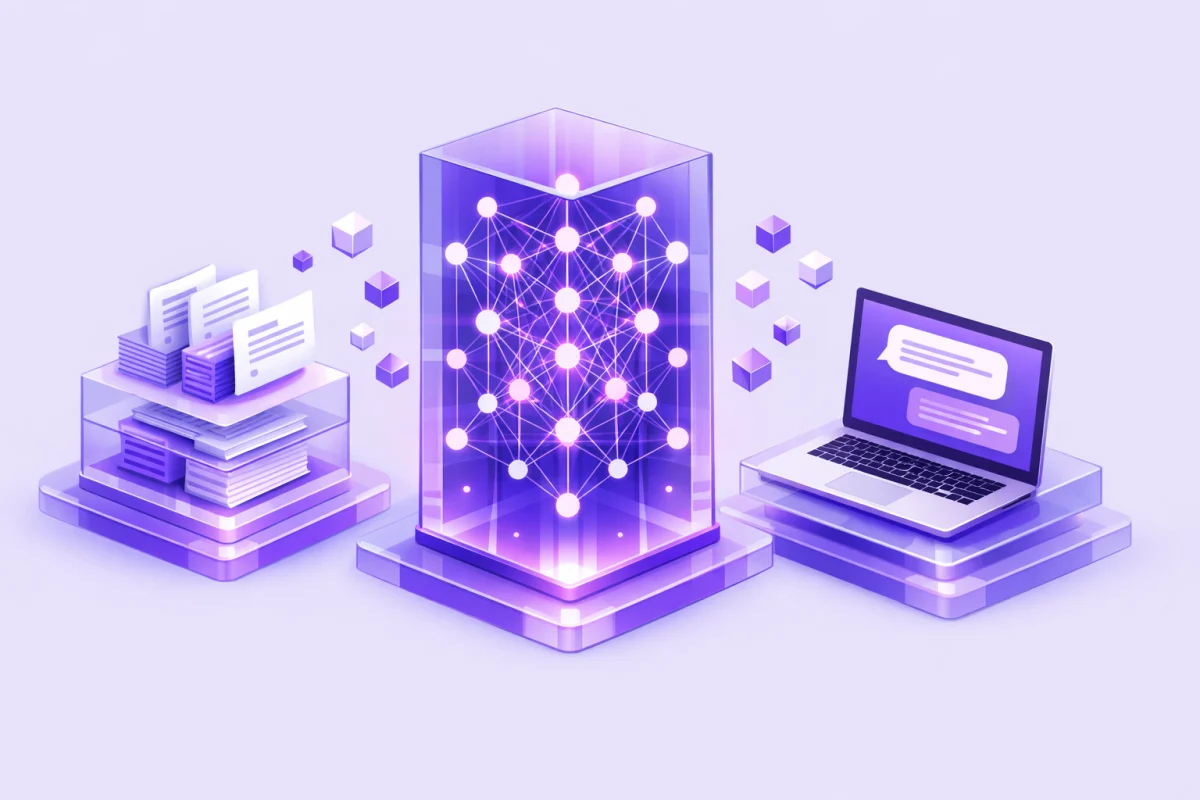
Large language models are a type of artificial intelligence designed to understand, interpret, and generate text that sounds like a human wrote it. They're called "large" because they contain billions (sometimes trillions) of parameters, which are essentially the numerical values the model adjusts during training to get better at predicting language.
You've probably already used an LLM without knowing it. ChatGPT, Claude, Gemini, and Copilot all run on large language models. When you ask these tools a question, write an email with their help, or have them summarize a document, you're interacting with an LLM.
But here's something important to understand: LLMs don't actually "know" things the way humans do. They're sophisticated pattern-matching systems. During training, they learn statistical relationships between words, phrases, and concepts. When you give them a prompt, they predict what text should come next based on those learned patterns.
For a foundational overview, check out understanding large language models simply.
How Do Large Language Models Work?
Understanding how LLMs work requires breaking down the process into a few key stages. Let's walk through each one.
Tokenization: Breaking Text into Pieces
Before an LLM can process your text, it needs to convert it into numbers. Computers don't understand words, so LLMs use tokenization to break text into smaller units called tokens.
A token might be a whole word, part of a word, or even a single character. For example, the word "understanding" might be split into "under" and "standing" as two separate tokens. Common words like "the" or "is" typically get their own token, while rare words get broken into subword pieces.
Each token gets assigned a unique numerical ID from the model's vocabulary. These IDs are what the model actually processes. When the LLM generates a response, it outputs token IDs that get converted back into readable text.
This is why you'll see AI companies mention "tokens" when discussing pricing and limits. Learn more about how LLMs process text with tokens.
The Transformer Architecture
The transformer architecture is what makes modern LLMs possible. Introduced in a 2017 research paper called "Attention Is All You Need," transformers solved a major problem that older AI models struggled with: understanding context across long sequences of text.
Before transformers, language models used recurrent neural networks (RNNs) that processed words one at a time in sequence. This made them slow and caused them to "forget" information from earlier in the text.
Transformers work differently. They process all tokens in parallel and use a mechanism called "attention" to figure out which words in a sentence are most relevant to each other.
For technical details, see our guide on transformer architecture explained.
Attention Mechanisms: The Secret Sauce
The attention mechanism is what gives LLMs their ability to understand context and relationships between words, even when those words are far apart in the text.
Think of it like this: when you read the sentence "The cat sat on the mat because it was tired," you intuitively know that "it" refers to "the cat." The attention mechanism helps the model make similar connections.
Here's how it works at a high level:
For each word (token) in the input, the model creates three vectors called Query, Key, and Value. The Query represents what the word is "looking for." The Key represents what the word "offers." The Value represents the actual information to pass along.
The model computes attention scores by comparing each word's Query to every other word's Key. Words with high scores "attend" to each other more strongly, allowing information to flow between relevant parts of the text.
This process happens multiple times in parallel through "multi-head attention," where different attention heads can focus on different types of relationships, like grammar, meaning, or long-range dependencies.
Dive deeper into attention mechanisms in AI.
Parameters and Weights
When people talk about model size, they're usually referring to the number of parameters. GPT-5.2 reportedly has over 1 trillion parameters. Llama 4 comes in sizes from 8 billion to 405 billion parameters.
Parameters are the numerical values that get adjusted during training. They're stored in matrices called "weights" that determine how information flows through the model's neural network layers.
More parameters generally means more capacity to learn patterns, but it also means higher computational costs for training and running the model. The relationship between size and capability isn't linear either, as training data quality and architecture design matter just as much.
Get the full breakdown in model parameters and weights explained.
How LLMs Are Trained
Training a large language model is expensive, time-consuming, and requires massive amounts of data and computational power. The process typically happens in three phases.
Pre-training: Learning Language Patterns
During pre-training, the model learns the basic patterns of language by processing enormous amounts of text data, often trillions of words scraped from books, websites, code repositories, and other sources.
The training objective is simple but powerful: predict the next word. Given a sequence like "The capital of France is," the model learns that "Paris" is a highly probable next word.
By doing this prediction task billions of times across diverse text, the model learns grammar, facts, reasoning patterns, and even some common sense. But it's all learned implicitly through statistics, not through explicit programming.
Pre-training requires thousands of GPUs running for weeks or months. This phase alone can cost tens of millions of dollars for the largest models.
Fine-tuning: Specialized Skills
After pre-training, models are often fine-tuned on smaller, more focused datasets to improve performance on specific tasks. This might involve training on high-quality question-answer pairs, code examples, or domain-specific documents.
Fine-tuning adjusts the model's weights to make it better at following instructions, answering questions, or performing other targeted tasks. It's much cheaper than pre-training because you're only adjusting an already-capable model, not teaching it language from scratch.
Alignment and RLHF
Raw pre-trained models can be impressive but also unpredictable. They might generate toxic content, refuse to help with legitimate requests, or produce responses that don't match what users actually want.
Reinforcement Learning from Human Feedback (RLHF) addresses this by training the model to produce outputs that humans prefer. The process works like this:
Human evaluators compare different model responses and indicate which ones are better. These preferences train a separate "reward model" that can score responses. The LLM then gets fine-tuned to maximize the reward model's scores.
RLHF is what makes models like ChatGPT and Claude feel helpful and aligned with user expectations. Without it, they'd just be powerful but chaotic text generators.
Learn more about training and inference fundamentals.
What Makes an LLM "Large"?
The "large" in large language model refers to scale across multiple dimensions.
Parameter Count
Most LLMs today have billions of parameters. Smaller models like Llama 4 Scout have around 17 billion parameters. The largest models, like GPT-5.2 or Google's Gemini 3, reportedly exceed 1 trillion parameters.
But bigger isn't always better. Smaller, well-trained models can outperform larger ones on specific tasks. The trend in 2025 and 2026 is toward more efficient models that do more with fewer parameters.
Training Data Size
Modern LLMs train on datasets measured in trillions of tokens. For context, all of Wikipedia is only about 4 billion tokens. These models have seen more text than any human could read in thousands of lifetimes.
Context Window
The context window determines how much text the model can process at once. Older models were limited to a few thousand tokens. Current models like Claude Opus 4.5 offer up to 200,000 tokens, while Google's Gemini 3 Pro can handle 1 million tokens.
A larger context window means the model can work with longer documents, maintain conversation history, and handle complex tasks that require synthesizing information from many sources.
Understand the implications in understanding context window limits.
Popular Large Language Models in 2026
The LLM guide wouldn't be complete without covering the major players. Here's where things stand as we enter 2026.
OpenAI's GPT-5.2
GPT-5.2, released in December 2025, is OpenAI's most capable model yet for professional knowledge work. It comes in three variants: Instant (optimized for speed), Thinking (for complex structured work like coding and planning), and Pro (maximum accuracy for difficult problems). GPT-5.2 features a 400,000 token context window, knowledge cutoff of August 2025, and achieves state-of-the-art results on benchmarks like GDPval, where it beats or ties top industry professionals on 70.9% of well-specified knowledge work tasks. The model excels at creating spreadsheets, building presentations, writing code, perceiving images, and handling complex multi-step projects.
Anthropic's Claude Opus 4.5
Claude Opus 4.5, released in November 2025, is Anthropic's flagship model known for being the "best model in the world for coding, agents, and computer use." It achieves 80.9% on SWE-bench Verified, making it the top performer for real-world software engineering tasks. The model offers a 200,000 token context window with 64,000 token output limit, and pricing starts at $5 per million input tokens. Claude Opus 4.5 can handle autonomous coding sessions lasting nearly five hours and excels at long-horizon tasks that require sustained reasoning.
Google's Gemini 3 Pro
Gemini 3 Pro, released in November 2025, is Google's most intelligent model with state-of-the-art reasoning capabilities. It features a 1 million token context window and processes text, images, video, audio, and code natively. The model shows more than 50% improvement over Gemini 2.5 Pro on benchmark tasks and excels at "vibe coding," where users describe what they want and the model builds interactive experiences. Gemini 3 Deep Think mode pushes reasoning even further for complex math, science, and logic problems. Google also released Gemini 3 Flash in December 2025, offering Pro-grade reasoning at faster speeds and lower costs.
Meta's Llama 4
The Llama 4 series, including Scout and Maverick variants, is notable for being open-weight, meaning developers can download and run the models on their own infrastructure. Llama 4 Scout supports context windows up to 10 million tokens, making it ideal for extensive research and documentation. These models offer flexibility and control compared to API-only options and are particularly popular for research and privacy-conscious applications.
Other Notable Models
Mistral AI offers efficient models popular in Europe with strong reasoning capabilities. DeepSeek from China provides competitive performance at significantly lower costs, with pricing starting at $0.28 per million input tokens. Cohere focuses on enterprise retrieval and search applications with their Command series. Grok from xAI integrates with X (formerly Twitter) for real-time information access.
Compare them yourself using comparing LLMs on leaderboards or explore the major AI model providers landscape.
LLM vs. SLM: When Size Matters
Not every task needs a 70-billion parameter model. Small language models (SLMs) are becoming increasingly capable and offer significant advantages for specific use cases.
SLMs run faster, cost less, and can even work locally on your device without sending data to the cloud. For simple classification, summarization of short texts, or basic Q&A, a well-tuned small model might perform just as well as a giant one.
The tradeoff is capability. Larger models generally handle complex reasoning, creative tasks, and nuanced understanding better. They also perform better on tasks outside their fine-tuning data.
The best approach often combines both: use small models for routine tasks and route complex queries to larger models when needed.
Compare the approaches in small vs large language models compared.
Foundation Models and Frontier Models
Two terms you'll encounter in this LLM guide are foundation models and frontier models.
Foundation models are large, pre-trained models designed to serve as a starting point for many applications. They're called "foundation" because you can build on top of them through fine-tuning or prompt engineering. GPT-5.2, Claude Opus 4.5, Llama 4, and Gemini 3 are all foundation models.
Frontier models refer to the most capable, cutting-edge models at any given time. These are the models pushing the boundaries of what AI can do, often from major labs like OpenAI, Anthropic, Google, and Meta. Today's frontier model becomes tomorrow's baseline.
The distinction matters for regulation too. Governments increasingly focus on frontier models because their advanced capabilities raise more significant safety and societal questions.
Get the full context in foundation models and frontier systems.
Open Source vs. Open Weights
The AI community uses these terms differently than the traditional software world.
Open weights means the trained model parameters are publicly available. You can download models like Llama and run them yourself. However, the training data, training code, and internal processes may not be shared.
Open source in the traditional sense would mean everything is available: the code, data, training procedures, and more. Few major LLMs meet this stricter definition.
For practical purposes, open-weight models like Llama give you significant flexibility. You can run them locally, fine-tune them on your data, and deploy them in ways that proprietary APIs don't allow. But you're still working with a black box in terms of how the model was actually created.
Understand the nuances in open weights and open source differences.
LLM Capabilities and Applications
So what can you actually do with large language models? The list keeps growing, but here are the major categories.
Text Generation and Writing
LLMs excel at generating coherent, contextually appropriate text. This includes drafting emails, writing reports, creating marketing copy, summarizing documents, and even producing creative writing like stories and poetry.
Code Generation
Models like GPT-5.2 Codex and Claude Opus 4.5 can write, explain, and debug code across dozens of programming languages. They've become essential tools for developers, helping with everything from autocomplete suggestions to generating entire functions from natural language descriptions.
Question Answering and Research
Need to understand a complex topic quickly? LLMs can synthesize information, answer questions, and explain concepts at various levels of detail. For research tasks, consider AI tools for research tasks.
Translation and Language Tasks
While dedicated translation models exist, LLMs handle translation surprisingly well, especially for common language pairs. They also excel at other language tasks like grammar correction, paraphrasing, and sentiment analysis.
Reasoning and Analysis
Modern LLMs can perform multi-step reasoning, analyze arguments, solve math problems, and work through logical puzzles. The reasoning capability varies significantly across models and improves with each generation. GPT-5.2 achieved 40.3% on FrontierMath, while Gemini 3 Pro leads on GPQA Diamond at 93.2%.
Agents and Automation
Increasingly, LLMs serve as the "brain" for AI agents that can use tools, browse the web, execute code, and complete multi-step workflows. Claude Opus 4.5 can handle autonomous tasks lasting nearly five hours, representing a major advancement in agentic AI capabilities.
To get better results from any LLM, explore crafting effective prompts.
Limitations of Large Language Models
No honest large language model explained guide would skip the limitations. Understanding these is crucial for using LLMs effectively.
Hallucinations
LLMs confidently generate false information. They might cite papers that don't exist, make up statistics, or state incorrect facts with complete certainty. Research suggests hallucination rates vary from 2% to over 80% depending on the task and domain.
This happens because LLMs predict likely text based on patterns, not truth. A factually incorrect statement might be "probable" based on the training data even if it's wrong. OpenAI's September 2025 research reframed hallucinations as a systemic incentive problem: training objectives and benchmarks often reward confident guessing over calibrated uncertainty.
Knowledge Cutoffs
LLMs only know what was in their training data. GPT-5.2 has a knowledge cutoff of August 2025, while Gemini 3 Pro's is January 2025. Ask about events after the cutoff date and they'll either refuse to answer, make something up, or give outdated information. Some models now have web search capabilities to partially address this.
Context Limitations
Despite improvements, all LLMs have finite context windows. They can lose track of earlier information in very long conversations or documents. Important details from the beginning of a conversation might be "forgotten" as the context fills up, though models like Gemini 3 Pro with 1 million token windows significantly reduce this issue.
Bias
LLMs reflect biases in their training data. This can manifest as stereotypes, unfair assumptions, or uneven performance across different demographics, languages, or topics. Alignment training reduces but doesn't eliminate these issues.
Reasoning Failures
While LLMs can perform impressive reasoning, they also fail in surprising ways. They might solve a hard math problem but miss an easy one with slightly different phrasing. Their reasoning isn't robust the way human understanding is.
Cost and Resource Intensity
Running large models requires significant computational resources. API costs add up quickly for high-volume applications. GPT-5.2 Pro costs $21 per million input tokens and $168 per million output tokens. Self-hosting requires expensive GPU infrastructure. This limits accessibility for smaller organizations.
How to Choose an LLM
With so many options, picking the right model depends on your specific needs.
For general tasks: Claude Opus 4.5 and GPT-5.2 offer the strongest all-around capabilities. Both handle writing, coding, analysis, and conversation well.
For coding: Claude Opus 4.5 leads with 80.9% on SWE-bench Verified for real-world bug fixing. GPT-5.2 Codex excels at agentic coding and cybersecurity tasks. GitHub Copilot integrates directly into development environments.
For cost-conscious applications: Smaller models like Llama 4 Scout, Mistral, or DeepSeek offer solid performance at a fraction of the cost. Gemini 3 Flash provides Pro-grade reasoning at lower prices.
For privacy-sensitive work: Open-weight models like Llama let you run everything locally or on private cloud infrastructure, keeping data off third-party servers.
For real-time information: Perplexity AI and Grok integrate web search, providing current information with citations.
For multimodal tasks: Gemini 3 Pro handles mixed input types (text, images, video, audio) natively with a 1 million token context window. GPT-5.2 and Claude also support image analysis.
Evaluate your options using evaluating models with benchmarks.
Deployment Options: Cloud vs. On-Device
How you deploy an LLM matters almost as much as which model you choose.
Cloud APIs
Most people access LLMs through cloud APIs (ChatGPT, Claude, Gemini). This is the easiest approach: no infrastructure to manage, always up to date, and you pay per use. The downsides are ongoing costs, data leaving your control, and dependency on the provider.
Self-Hosted Cloud
You can run open-weight models on your own cloud infrastructure (AWS, Azure, GCP). This gives you more control and can reduce costs at scale, but requires DevOps expertise and GPU resources.
On-Device
Smaller models can now run directly on laptops and even phones. This offers privacy (data never leaves the device), works offline, and eliminates API costs. The tradeoff is limited capability compared to larger cloud models.
The trend is toward hybrid approaches where simple queries run locally and complex ones route to cloud APIs.
Compare approaches in on-device versus cloud deployment.
The Future of Large Language Models
Where are LLMs headed? A few trends are clear.
Better reasoning: Models are getting better at complex, multi-step reasoning. Techniques like chain-of-thought prompting and "thinking" modes (like Claude's extended thinking, GPT-5.2's Thinking mode, or Gemini 3's Deep Think) push this further. GPT-5.2 achieved 52.9% on ARC-AGI-2, up from 17.6% for GPT-5.1.
Longer context: Context windows keep expanding. Gemini 3 Pro offers 1 million tokens. Llama 4 Scout reaches 10 million. The goal is models that can process entire codebases, book-length documents, or months of conversation history seamlessly.
More efficient: Research focuses on getting more capability from smaller models. Mixture-of-experts architectures and distillation techniques help achieve this. Gemini 3 Flash delivers Pro-grade reasoning at Flash-level speed and cost.
Multimodal by default: The distinction between "language model" and "vision model" is blurring. Future models will natively handle text, images, audio, video, and other modalities together.
Agentic capabilities: LLMs are becoming central components in AI agents that can take actions, use tools, and complete complex workflows with minimal human oversight. Claude Opus 4.5 can handle autonomous tasks for nearly five hours.
Reduced hallucinations: While hallucinations may never be completely eliminated, better training techniques and architectural improvements are making models more reliable. GPT-5.2 shows significantly fewer hallucinations than previous versions, especially when using its reasoning modes.
Getting Started with LLMs
Ready to explore large language models yourself? Here's where to begin.
Try the major chatbots: Create free accounts on ChatGPT (chat.openai.com), Claude (claude.ai), and Gemini (gemini.google.com). Compare how they handle the same prompts.
Learn prompt engineering: The quality of your prompts dramatically affects your results. Invest time learning how to write clear, specific prompts that get the outputs you want.
Understand the ecosystem: Browse the full range of AI tools built on LLMs. Ready to find the right tool? Browse the list of AI software to explore options that fit your workflow.
Stay current: The field moves fast. What's cutting-edge today becomes standard quickly. Follow AI news sources and experiment with new models as they launch.
Build something: The best way to understand LLMs is to use them for real projects. Start simple: automate a repetitive writing task, build a Q&A bot for your documents, or use code generation to speed up development.
For a deeper understanding of the technology behind these systems, explore deep learning and neural networks.