What Are the Types of AI Agents and Why Should You Care?
AI agents are everywhere now. They're processing your insurance claims, routing your customer support tickets, and even writing code while you sleep. But here's what most people miss: not all AI agents work the same way.
Understanding the different types of AI agents isn't just academic stuff. It's the difference between automating a process that saves your team 10 hours a week versus building something that breaks every time conditions change.
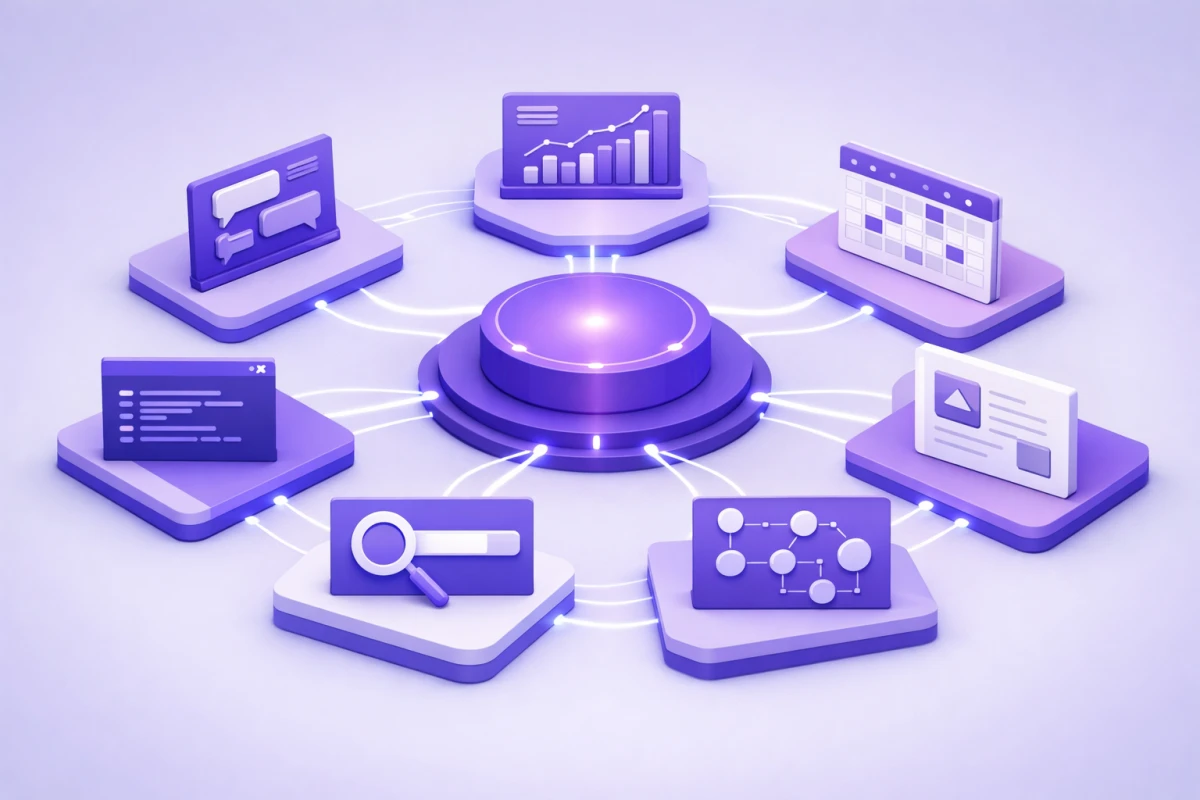
The seven main AI agent categories each solve different problems. Some react instantly to triggers. Others plan ahead and optimize outcomes. A few can learn and improve without being reprogrammed. Picking the wrong type for your workflow is like using a hammer when you need a screwdriver. It might technically work, but you'll waste time and energy getting there.
By 2026, Gartner predicts 40% of enterprise applications will include task-specific AI agents. That's a massive jump from under 5% in 2025. Companies already using agents report workflow cycles 20 to 30% faster. But the organizations seeing the best results aren't just throwing agents at problems. They're matching the right agent type to each specific challenge.
For a deeper foundation on this technology, check out our complete AI agents guide that covers the fundamentals.
How Do AI Agent Categories Differ From Each Other?
Classifying AI agents comes down to three factors: how they perceive their environment, how they make decisions, and whether they can improve over time.
At one end, you have agents that respond to the current moment with zero memory of what happened before. At the other end, you have systems that maintain detailed models of their environment, plan sequences of actions toward goals, and get better through experience.
The agent types build on each other. Simple reflex agents are the foundation. Model-based agents add memory. Goal-based agents add planning. Utility-based agents add optimization. Learning agents add adaptation. Hierarchical and multi-agent systems combine these capabilities for complex enterprise workflows.
Think of it like a career ladder. You wouldn't put a junior analyst in charge of corporate strategy. Similarly, you wouldn't deploy a simple reflex agent to handle claims processing that requires weighing multiple factors and learning from fraud patterns.
Let's break down each type so you can match agent types to your specific workflow challenges.
1. Simple Reflex Agents: Fast Responses for Predictable Situations
Simple reflex agents are the most basic form of intelligent automation. They operate on condition-action rules, essentially sophisticated if-then statements. When a specific input appears, the agent produces a specific output. No memory. No planning. Just instant reaction.
These agents work by continuously monitoring their environment through sensors. When they detect a trigger condition, they execute the corresponding action. That's it.
How they work: The agent perceives something in its environment. It checks that perception against its rule set. If a rule matches, it fires the associated action. If nothing matches, it does nothing or falls back to a default behavior.
Real examples in workflows:
- Thermostats that activate heating when temperature drops below a threshold
- Smoke detectors that trigger alarms when detecting particles
- Auto-responder emails that send acknowledgments when tickets arrive
- Assembly line sensors that stop machinery when detecting obstructions
- Motion-activated lighting systems in office buildings
Simple reflex agents shine in fully observable, predictable environments. If you can write out every possible scenario and the correct response, these agents will execute flawlessly every time. They're reliable, fast, and resource-efficient.
But they fall apart in dynamic situations. A simple reflex agent can't handle ambiguity. It doesn't remember what happened five minutes ago. It can't adapt when conditions change outside its programmed rules.
For workflow automation with agents, simple reflex systems work best as building blocks within larger automation architectures. They handle the instant-response layer while more sophisticated agents manage complex decisions above them.
2. Model-Based Reflex Agents: Adding Memory to the Mix
Model-based reflex agents improve on simple reflex systems by maintaining an internal model of the world. This internal state tracks what the agent can't directly observe and remembers relevant history.
Where simple reflex agents only see the present, model-based agents understand context. They know what happened before and can predict how their actions might affect the environment.
How they work: The agent maintains a representation of its environment that gets updated with each new perception. When making decisions, it consults both current input and this stored model. The model includes information about how the world typically works and how the agent's previous actions affected outcomes.
Real examples in workflows:
- Smart thermostats that learn usage patterns and pre-heat before you arrive home
- Self-driving vehicle systems that track surrounding vehicles' positions and predict their movements
- Fraud detection systems that flag transactions based on historical account behavior
- Inventory management that considers seasonal patterns and past demand
- Chatbots that remember conversation history within a session
Model-based agents handle partially observable environments much better than simple reflex agents. They can infer information that isn't directly visible. If a customer support agent knows that a user already tried restarting their device, it won't suggest that solution again.
JP Morgan's AI fraud detection reportedly reduced fraud by 70% and saved $200 million annually by using model-based agents that adapt to evolving tactics. The system doesn't just react to known fraud patterns. It maintains models of normal behavior and flags deviations.
The trade-off is complexity. Model-based agents require more computational resources. The internal model needs regular updating. If the model becomes inaccurate, the agent makes poor decisions based on outdated assumptions.
Understanding intelligent agent fundamentals helps you recognize when a simple reflex agent won't cut it and when you need the memory and context awareness that model-based systems provide.
3. Goal-Based Agents: Working Backward From Objectives
Goal-based agents introduce something neither reflex type has: a destination. Instead of just reacting to the environment, these agents evaluate potential actions based on whether they move toward a specific objective.
This fundamentally changes how agents operate. They don't just respond to what's happening now. They consider future consequences and plan sequences of actions that lead toward their goals.
How they work: The agent maintains one or more goals that represent desired states. When choosing an action, it simulates different possibilities and selects options that make progress toward those goals. This often involves search algorithms that explore multiple potential paths before committing to one.
Real examples in workflows:
- GPS navigation calculating routes to reach destinations efficiently
- Robotic vacuum cleaners systematically covering all floor space
- Project management systems that schedule tasks to meet deadlines
- Chess engines like Stockfish that plan moves toward checkmate
- Warehouse robots that optimize picking paths across multiple orders
Goal-based agents excel when you can clearly define what success looks like. Navigation is a perfect example: success means arriving at the destination. The agent explores different routes, accounts for traffic and road conditions, and selects the path most likely to achieve that goal.
What makes goal-based agent systems powerful is their flexibility. If conditions change mid-execution, they can re-plan. If traffic suddenly blocks the recommended route, a goal-based navigation agent recalculates. A simple reflex agent following turn-by-turn instructions would get stuck.
The limitation is that goal-based agents need well-defined goals. They measure success in binary terms: either you reached the destination or you didn't. When multiple acceptable outcomes exist or when trade-offs between competing priorities matter, goal-based agents struggle.
4. Utility-Based Agents: Optimizing for the Best Outcome
Utility-based agents extend goal-based thinking by asking not just "will this achieve my goal?" but "how good is this outcome compared to alternatives?"
These agents use utility functions that assign numerical values to different states. Instead of simply reaching any acceptable solution, they seek the solution that maximizes overall value. This enables sophisticated trade-off analysis that goal-based agents can't perform.
How they work: The agent evaluates potential outcomes using a utility function that quantifies desirability. When multiple actions could achieve a goal, the agent calculates expected utility for each option and selects the one with the highest score. The utility function can account for multiple criteria: speed, cost, risk, quality, and any other measurable factor.
Real examples in workflows:
- Stock trading bots that balance profit potential against risk exposure
- Dynamic pricing engines that maximize revenue based on demand patterns
- Smart energy systems balancing comfort, cost, and environmental impact
- Recommendation engines optimizing for user engagement and satisfaction
- Insurance underwriting systems weighing risk factors against premium potential
Netflix's recommendation system is a classic utility-based agent. The goal isn't just "show the user something they'll watch." The utility function optimizes for how likely you are to click, watch through to the end, and come back for more. It constantly weighs options against each other to surface the content with highest expected engagement.
The difference between utility-based decision making and goal-based thinking becomes clear in financial applications. A goal-based trading agent might have the objective "make $1000 profit today." A utility-based agent considers risk-adjusted returns, transaction costs, portfolio balance, and regulatory constraints, then selects trades that optimize across all these dimensions simultaneously.
Utility-based agents require careful design of the utility function. If the function doesn't accurately capture what you actually value, the agent will optimize for the wrong things. Get it right, and you have a system that consistently finds optimal solutions in complex decision spaces.
5. Learning Agents: Systems That Improve Over Time
Learning agents add something critical that all previous types lack: the ability to get better without being reprogrammed. They observe the outcomes of their actions, receive feedback, and adjust their behavior accordingly.
This makes learning agents essential for environments where you can't anticipate every scenario. Instead of coding perfect rules upfront, you give the agent mechanisms to discover effective strategies through experience.
How they work: Learning agents have four main components. The learning element updates the agent's knowledge based on new data. The performance element chooses actions using current knowledge. The critic evaluates outcomes against goals and provides feedback. The problem generator suggests new actions to try for better learning. These components work together to continuously refine the agent's capabilities.
Real examples in workflows:
- Spam filters that improve accuracy based on user corrections
- Personalized assistants like Alexa that learn user preferences over time
- Autonomous vehicles that adapt to new road conditions
- Security systems that evolve to detect novel threats
- Content recommendation systems that refine suggestions based on feedback
Learning agents are critical in dynamic environments where conditions constantly shift. A spam filter trained on 2024 email patterns would miss 2026's phishing techniques. But a learning agent continuously incorporates feedback, staying effective even as threats evolve.
For complex automation scenarios, learning agents can discover approaches that human programmers wouldn't think of. Tesla's Autopilot learns from millions of miles of driving data across its entire fleet. That collective learning enables the system to handle edge cases no individual programmer could anticipate.
The catch is that learning agents need quality feedback and enough examples to learn from. They can also learn the wrong lessons if feedback is inconsistent or biased. Understanding agent maturity levels helps you gauge when a learning agent has trained enough to deploy confidently.
6. Hierarchical Agents: Coordinating Specialized Sub-Agents
Hierarchical agents organize multiple specialized agents into layered structures where higher-level agents coordinate lower-level ones. This architecture handles complex tasks by decomposing them into manageable subtasks that simpler agents can execute.
Think of it like corporate structure. Executives set strategy. Managers translate strategy into objectives. Individual contributors execute specific tasks. Each level operates at different time scales and abstraction levels.
How they work: The hierarchy typically includes a reactive layer for fast, real-time responses. A deliberative layer handles state estimation, planning, and mid-horizon decisions. A meta-cognitive layer manages long-term goals, monitors strategy effectiveness, and adapts approaches. Information flows both up and down the hierarchy, with high-level agents providing direction and low-level agents providing execution feedback.
Real examples in workflows:
- Revenue operations systems where a planning agent coordinates data entry, analysis, and reporting agents
- Supply chain management with strategy, procurement, logistics, and tracking agents
- Customer support systems routing between specialized troubleshooting agents
- Content creation pipelines coordinating research, writing, editing, and formatting agents
- Insurance claims processing with planner, verification, fraud detection, and payout agents
One insurance company deployed seven specialized agents to handle claims: a planner that starts workflows, a cyber agent for data security, coverage and weather verification agents, a fraud detection agent, a payout calculation agent, and an audit agent that summarizes for human review. The result was 80% faster processing, cutting claims from days to hours.
Hierarchical agent architecture design separates concerns effectively. Safety-critical logic stays in fast reactive layers where delays could cause problems. Expensive reasoning and planning happens at higher levels where speed matters less than accuracy.
The challenge is coordination overhead. Information must flow between layers, and errors at higher levels cascade down. You also need clear interfaces between agents so they can collaborate without conflicting.
7. Multi-Agent Systems: Teams of Agents Solving Complex Problems
Multi-agent systems combine multiple AI agents that work together, compete, or both to achieve outcomes that single agents couldn't handle alone. Instead of one monolithic intelligence, you get an ecosystem of specialized capabilities.
This mirrors how effective human teams operate. You don't ask one person to handle sales, engineering, support, and finance. You build teams with complementary skills who collaborate toward shared goals.
How they work: Each agent in the system has distinct roles, capabilities, and sometimes conflicting objectives. An orchestration layer coordinates communication and task allocation. Agents might cooperate by sharing information and dividing work. They might compete when pursuing scarce resources. Many real systems blend cooperation and competition depending on the situation.
Real examples in workflows:
- Amazon warehouse automation with hundreds of robots coordinating inventory retrieval
- Financial trading platforms where multiple strategy agents compete for best execution
- Smart city traffic management across networks of intersection agents
- Autonomous vehicle fleets coordinating navigation and avoiding conflicts
- Enterprise ERP systems with specialized finance, HR, and operations agents
Self-driving cars provide a clear illustration. A single vehicle combines utility-based agents for route optimization, goal-based agents for destination tracking, model-based agents for environmental awareness, and learning agents that improve from experience. The car works because these different agent types collaborate effectively.
McKinsey research shows the highest-performing AI organizations treat agents as collaborative teams rather than isolated tools. They redesign workflows around agent collaboration and see measurably better results than companies deploying single-purpose agents in isolation.
Understanding agentic design patterns helps you architect multi-agent systems that collaborate effectively rather than stepping on each other's work.
How to Choose the Right AI Agent Type for Your Workflows
Matching different AI agents to specific workflow challenges comes down to a few key questions:
Is your environment predictable with clear rules? Simple reflex agents work perfectly for stable, well-defined situations. Don't over-engineer when basic automation solves the problem.
Do you need context from past events? Model-based agents track history and make decisions based on patterns over time. Essential for anything that requires understanding "what happened before."
Can you define clear success criteria? Goal-based agents plan toward specific objectives. If you know exactly what "done" looks like, these agents will find paths to get there.
Are there trade-offs between multiple priorities? Utility-based agents optimize across competing factors. When "good enough" isn't acceptable and you need the best possible outcome, utility functions deliver.
Will conditions change in ways you can't predict? Learning agents adapt to new situations. When you can't anticipate every scenario, let the agent discover effective approaches through experience.
Is the task too complex for a single agent? Hierarchical and multi-agent systems decompose complexity into manageable pieces. Enterprise-scale workflows almost always need coordinated teams of specialized agents.
For practical guidance on selecting agents for tasks, start with the simplest agent type that could work and add complexity only when needed. Over-engineering creates maintenance headaches and performance bottlenecks.
What Platforms Help You Build AI Agents?
The tools for building AI agents have matured significantly. You no longer need a machine learning PhD to deploy effective automation.
Low-code and no-code platforms like n8n, Flowise, and Kissflow let business users describe workflows in natural language or visual builders. The platform handles translation to executable agent logic.
Developer frameworks like LangChain, AutoGen, and CrewAI provide code-level control for complex agent systems. These work well when you need custom behavior that visual tools can't express.
Enterprise platforms like Salesforce Agentforce, Microsoft Copilot Studio, and IBM watsonx embed agents directly into existing business systems. They're optimized for organizations already invested in those ecosystems.
Google released its Agent Development Kit in 2025, specifically designed for multi-agent systems with hierarchical coordination. NVIDIA's Nemotron 3 family targets high-throughput multi-agent deployments.
Explore platforms for building agents to compare options based on your technical capabilities and integration requirements.
What's the Difference Between LLM Agents and Traditional AI Agents?
The seven types we've covered represent the classical taxonomy. But 2025 and 2026 have seen a new category emerge: agents powered by large language models like GPT-5.2, Claude Opus 4.5, and Gemini 3 Pro.
LLM-powered agents blur the traditional boundaries. They can reason about goals, maintain context, learn from interactions, and coordinate with other systems. A single LLM agent might exhibit characteristics of multiple traditional agent types.
What distinguishes LLM-powered agent categories is their foundation in language understanding. They interpret instructions in natural language, reason about problems conversationally, and can explain their actions in terms humans understand.
Traditional agents follow programmed logic. LLM agents can handle novel situations by reasoning from first principles. This makes them more flexible but also less predictable. The same prompt might produce different results depending on how the model interprets context.
For enterprise workflows, the trend is combining both approaches. LLM agents handle interpretation, reasoning, and coordination. Traditional agents handle execution where consistency and speed matter. The result is systems that are both intelligent and reliable.
What Challenges Should You Expect When Deploying AI Agents?
Agent deployment isn't plug-and-play. Industry research shows 90% of AI agents fail within 30 days because they can't handle messy, unpredictable business operations.
Security concerns top the list for 74% of organizations. Agents that access business systems create attack surfaces. Agents that make autonomous decisions can be manipulated through adversarial inputs.
Coordination complexity grows exponentially with multi-agent systems. Agents can optimize for conflicting goals, create deadlocks, or produce emergent behaviors nobody anticipated.
Accuracy and hallucination issues plague LLM-based agents. They can confidently produce incorrect outputs that look legitimate. Human oversight remains essential for high-stakes decisions.
Integration challenges arise when agents need to work with legacy systems. APIs, data formats, and security protocols vary widely across enterprise software.
Successful organizations start small. They pick one well-defined workflow, deploy the simplest agent type that could work, measure results rigorously, and expand only after proving value. Trying to automate everything at once almost always fails.
Ready to Streamline Your Workflows With AI Agents?
AI agents are transforming how businesses operate. The right agent type can cut processing times by 80%, save hundreds of hours weekly, and enable workflows that simply weren't possible before.
But success requires matching agent capabilities to actual problems. Simple reflex agents for instant responses in predictable environments. Model-based agents when context matters. Goal-based agents for clear objectives. Utility-based agents for optimization. Learning agents for adaptation. Hierarchical and multi-agent systems for enterprise-scale complexity.
Start by identifying one workflow that drains time without adding value. Map it against the agent types we've covered. Choose the simplest approach that could work. Test, measure, and iterate.
Ready to find the right tool? Browse our AI agent marketplace to explore options that fit your specific workflow needs.
For workflow automation tools designed around modern agent architectures, look for platforms that support the agent types your workflows actually need rather than forcing everything through one-size-fits-all automation.
The organizations winning with AI agents aren't necessarily the ones with the biggest budgets or most advanced technology. They're the ones who understand different AI agents have different strengths and match the right tool to each job.