TL;DR
- LLM agents combine large language models with planning, memory, and tool use to complete complex tasks autonomously
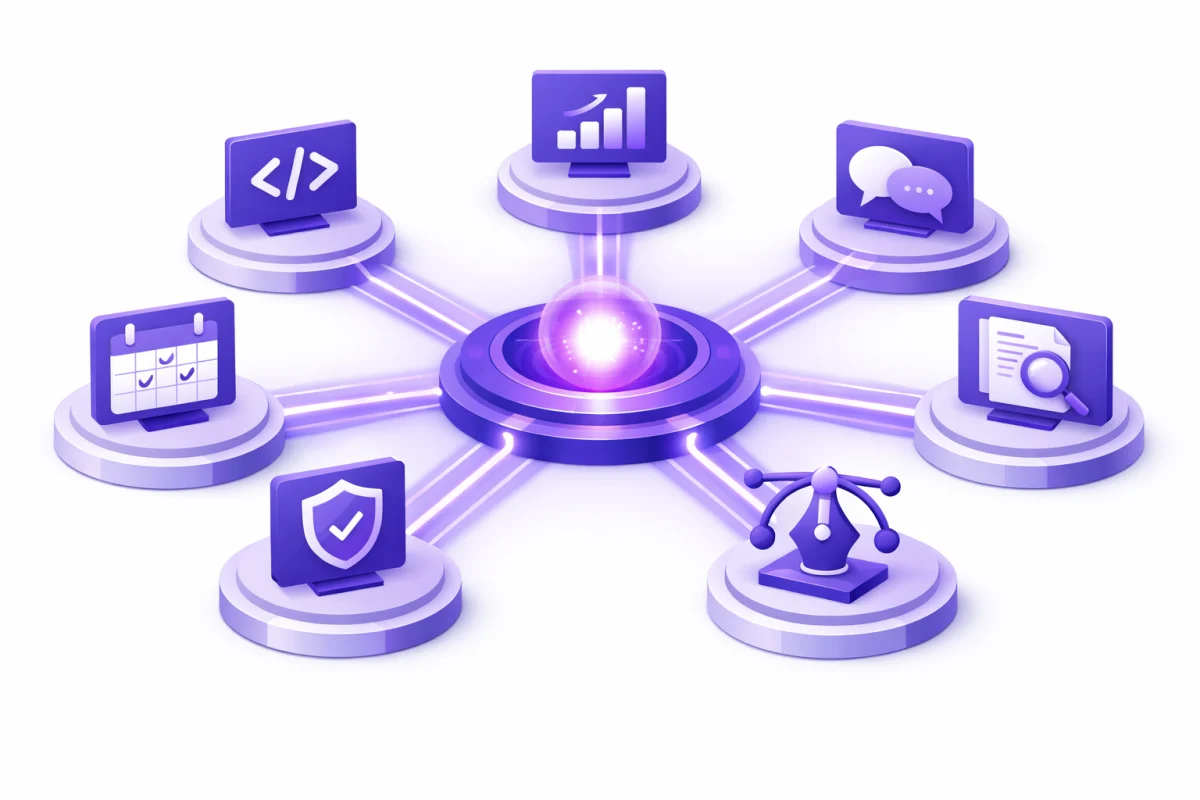
- The seven main types include ReAct agents, conversational agents, task-oriented agents, multi-agent systems, RAG agents, coding agents, and research agents
- ReAct agents use a think-act-observe loop that reduces hallucinations and improves reasoning accuracy
- Multi-agent systems enable specialized AI "teams" that collaborate on complex problems
- Choosing the right agent type depends on your task complexity, autonomy needs, and integration requirements
What Are LLM Agents and Why Should You Care?
LLM agents aren't just chatbots with extra features. They're autonomous systems that can reason through problems, use external tools, remember past interactions, and take actions to accomplish goals. Think of them as AI assistants that can actually get stuff done rather than just talk about it.
The difference between a standard language model and an LLM-powered agent comes down to four core capabilities. First, there's planning, where the agent breaks complex tasks into manageable steps. Then comes memory, both short-term for the current conversation and long-term for retaining useful information across sessions. Tool use lets agents interact with APIs, databases, search engines, and other software. Finally, action execution means they can actually do things rather than just suggest them.
According to Deloitte's research, 25% of companies using generative AI launched agentic AI pilots in 2025, with projections showing 50% adoption by 2027. This shift from passive AI assistants to active AI workers represents one of the biggest changes in how large language models work in practical applications.
If you're trying to understand what defines a language model, think of agents as the layer that transforms raw language understanding into purposeful behavior. The model itself provides intelligence. The agent framework provides agency.
How Do LLM Agents Actually Work?
Every LLM agent shares a basic architecture, regardless of its specific type. At the center sits the language model itself, serving as the "brain" that processes information and makes decisions. Surrounding this core are several key components that enable autonomous operation.
The planning module handles task decomposition. When you ask an agent to "research competitors and create a summary report," it doesn't try to do everything at once. Instead, it breaks this into steps: identify competitors, gather information on each, analyze findings, structure the report, write each section. Popular techniques for this include Chain of Thought prompting for single-path reasoning and Tree of Thoughts for exploring multiple solution paths.
Memory gives agents context. Short-term memory typically means the conversation history and any working notes within the current session. Long-term memory stores information across sessions, often using vector databases to retrieve relevant past interactions or learned facts.
The tool interface connects agents to the outside world. This might include web search APIs, code interpreters, database connections, calendar systems, or any other software the agent needs to complete its tasks. When the agent determines it needs external information, it formulates a tool call, receives the result, and incorporates that information into its reasoning.
Understanding these fundamentals helps when exploring general AI agent categories, since all agent types build on this shared foundation while specializing in different directions.
Type 1: ReAct Agents
ReAct stands for "Reasoning and Acting," and it's become one of the most influential patterns for building LLM agents. Introduced by Yao and colleagues in 2023, this framework combines chain-of-thought reasoning with external tool use in an interleaved manner.
Here's how the reasoning loop patterns work in practice. The agent receives a question like "What's the current market cap of the company that acquired Instagram?" First comes a Thought: "I need to find out which company acquired Instagram." Then an Action: Search for "Instagram acquisition." The Observation returns: "Facebook acquired Instagram in 2012 for $1 billion." Another Thought follows: "Now I need to find Facebook's current market cap." The cycle continues until the agent reaches a final answer.
This approach solves several problems that plague standalone language models. By grounding reasoning in actual tool results, ReAct agents hallucinate less frequently. The explicit thought traces make it easier to debug when something goes wrong. And the ability to fetch real-time information means agents aren't limited to their training data cutoff.
Research shows ReAct outperforms chain-of-thought prompting alone on tasks requiring external knowledge, and it beats pure action-based approaches on tasks requiring multi-step reasoning. The combination proves more powerful than either technique in isolation.
Most modern agent framework comparisons include ReAct as a baseline or building block. LangChain, AutoGen, and CrewAI all support ReAct-style agents, though they layer additional capabilities on top. If you're building your first agent system, ReAct is often the pattern to start with.
Type 2: Conversational Agents
Conversational agents focus on natural, engaging dialogue rather than task completion. They're designed to understand context, maintain personality consistency, and provide responses that feel human-like across extended interactions.
These agents power customer support chatbots, virtual companions, and interactive assistants. Unlike simple Q&A systems, conversational agents track conversation history, adapt their tone to match users, and handle the ambiguity that comes with natural language. When someone says "What about the other one?", a conversational agent understands they're referencing something mentioned earlier.
The key differentiator is persona engineering. Developers define characteristics like expertise areas, communication style, and even simulated personality traits. A conversational agent for a financial services company might be instructed to maintain a professional, helpful tone while avoiding specific investment advice. One designed for a gaming platform might adopt a more casual, enthusiastic personality.
Memory plays a crucial role here. Short-term memory lets the agent reference recent messages accurately. Long-term memory can store user preferences, past interactions, and learned information about individual users. This creates the feeling of talking to someone who actually knows you.
Several companies have demonstrated success with conversational agents for customer support, including usage-based pricing models where they charge only for successful resolutions. This confidence in resolution rates shows how far conversational AI has come from the frustrating chatbots of a few years ago.
Type 3: Task-Oriented Agents
While conversational agents prioritize dialogue quality, task-oriented agents focus on getting things done. They're built to complete specific objectives: scheduling meetings, processing orders, updating databases, generating reports, or automating workflows.
The architecture differs from conversational systems in important ways. Task-oriented agents need clear success criteria. They integrate more heavily with external tools and APIs. And they often operate with minimal ongoing human interaction, checking in only when they encounter problems or need approval.
Consider an agent designed to handle invoice processing. It receives an email with an attachment, extracts the document, identifies key fields like vendor name, amount, and due date, validates the information against existing records, routes it for approval based on predefined rules, and updates the accounting system once approved. Each step requires different tools and may involve conditional logic based on the extracted data.
Automation platforms like Zapier have introduced AI agents that work across 7,000+ applications, handling everything from lead routing to report generation. These represent task-oriented agents at scale, connecting disparate systems through a unified AI interface.
The function calling in agents capability makes these systems possible. Rather than just generating text responses, the agent can call structured functions with specific parameters. This might mean invoking an API to create a calendar event, send an email, or update a CRM record. The LLM decides which function to call and with what arguments based on the task requirements.
Type 4: Multi-Agent Systems
Sometimes one agent isn't enough. Multi-agent systems deploy multiple specialized agents that collaborate, each handling different aspects of a complex task. Think of it like a team where one person handles research, another writes code, a third reviews for quality, and a manager coordinates everyone's work.
This approach offers several advantages over single-agent architectures. Specialization lets each agent focus on what it does best rather than trying to be a generalist. Parallel processing means multiple agents can work on different subtasks simultaneously. And fault tolerance improves because if one agent fails, others can compensate or take over.
The collaboration patterns vary. In hierarchical systems, a supervisor agent delegates tasks to worker agents and aggregates their outputs. Peer-to-peer systems let agents communicate directly, passing information and negotiating responsibilities. Some implementations use voting or consensus mechanisms when agents disagree.
Microsoft's AutoGen, for example, treats workflows as conversations between agents. You might define a Planner agent, a Coder agent, and a Critic agent. When given a programming task, the Planner breaks it into steps, the Coder implements each step, and the Critic reviews the code and suggests improvements. They literally talk to each other until the task is complete.
MetaGPT takes this further by simulating entire software development teams. Different agents adopt roles like product manager, architect, engineer, and QA tester. The system can generate complete codebases by having agents collaborate through their defined responsibilities.
Research from Anthropic and others suggests multi-agent collaboration can improve accuracy by up to 40% on complex tasks through cross-validation, where agents verify each other's outputs and catch errors that a single agent might miss.
Type 5: RAG Agents
Retrieval-Augmented Generation agents combine LLMs with external knowledge retrieval. Rather than relying solely on what the model learned during training, RAG agents fetch relevant information from databases, documents, or the web before generating responses.
The basic RAG pattern works like this. A user asks a question. The system embeds that question into a vector and searches a database of similarly embedded documents. It retrieves the most relevant chunks and passes them along with the original question to the language model. The model generates a response grounded in the retrieved context.
But simple RAG has limitations. It can retrieve irrelevant information, miss relevant documents, or struggle with multi-hop questions that require synthesizing information across sources. This is where agentic RAG comes in.
Agentic RAG embeds autonomous agents into the retrieval pipeline. The agent can reformulate queries when initial results are poor, perform multiple retrieval rounds to gather comprehensive information, route queries to different knowledge sources based on content type, and validate retrieved information before using it.
According to research published in early 2025, agentic RAG systems transcend traditional limitations by leveraging agentic design patterns like reflection, planning, tool use, and multi-agent collaboration. This lets them dynamically manage retrieval strategies and iteratively refine their understanding.
The practical difference is significant. A basic RAG system might retrieve three document chunks and generate an answer. An agentic RAG system might analyze the query, decide it needs information from multiple sources, retrieve from a company knowledge base and a web search, synthesize the findings, verify key facts, and produce a response with appropriate citations.
For applications requiring up-to-date or specialized knowledge, RAG agents bridge the gap between general language models and domain-specific expertise without expensive fine-tuning.
Type 6: Coding Agents
Coding agents represent one of the fastest-growing agent categories. These systems go beyond code completion to handle entire development tasks: writing new features, debugging issues, refactoring codebases, and even managing version control.
Claude Code, released by Anthropic in early 2025, exemplifies this category. It operates directly in the terminal, understands entire codebases, executes multi-step tasks, and maintains context across complex projects. According to Google's 2025 DORA Report, 90% of developers now use AI coding assistants, with 65% reporting heavy reliance on these tools.
What makes coding agents for development different from autocomplete tools? First, codebase awareness. Coding agents can read and understand multiple files, following imports and references to build a mental model of the project structure. Second, autonomous execution. They can run tests, observe results, and iterate on solutions without constant human guidance. Third, tool integration. They connect with version control, CI/CD pipelines, and other development infrastructure.
The results speak for themselves. Anthropic reports that Opus 4.5 achieves higher pass rates on coding benchmarks while using up to 65% fewer tokens than previous models. More impressively, documented cases show autonomous operation exceeding 30 hours on complex multi-step tasks.
For developers, this shifts the workflow from writing code to reviewing and guiding AI-generated code. One developer noted they built a project with 20,000 lines of code, complete with audit logging, a full database schema, and a four-phase implementation roadmap in a single session. Another observed that Claude Code lets people with no coding experience build and deploy simple applications.
The subagent pattern has emerged as particularly powerful for coding tasks. A main agent coordinates while specialized subagents handle exploration, planning, or implementation. This mirrors how senior engineers delegate to team members while maintaining oversight of the overall architecture.
Type 7: Research and Deep Research Agents
Research agents tackle knowledge-intensive tasks that require gathering, synthesizing, and analyzing information from multiple sources. They're designed for questions that can't be answered with a single search query, where understanding requires connecting dots across documents, verifying facts, and building comprehensive understanding.
The Deep Research pattern gained popularity in 2024 and early 2025. Rather than quick responses, these agents spend extended time (sometimes 15+ minutes or more) churning through information to produce detailed reports. They decompose complex questions into sub-queries, search multiple sources, read and extract relevant information, and synthesize findings into coherent analysis.
Modern research agents integrate several specialized capabilities. A search agent handles web queries and navigation. A browsing agent reads and extracts information from web pages. A code interpreter analyzes data, performs calculations, or generates visualizations. Memory maintains context as the research progresses across multiple steps.
This architecture can handle queries like "What are the legal implications of recent AI regulation proposals across the EU, US, and China, and how might they affect multinational tech companies?" A simple search can't answer this. But a research agent can systematically investigate each jurisdiction, extract relevant legal provisions, identify commonalities and differences, and produce a comparative analysis.
GPT Researcher, an autonomous agent project, exemplifies this category. It generates research reports by breaking questions into components, searching multiple sources, and synthesizing comprehensive answers. Similar capabilities appear in commercial products from OpenAI, Google, and others.
For organizations needing in-depth analysis, market research, competitive intelligence, or academic synthesis, research assistant tools powered by these agents can accomplish in minutes what would take human researchers hours.
How Do You Choose the Right LLM Agent Type?
Selecting an agent architecture depends on several factors: task complexity, autonomy requirements, integration needs, and acceptable latency and cost.
For simple, well-defined tasks with clear success criteria, task-oriented agents or basic ReAct patterns often suffice. They're easier to build, debug, and maintain. The overhead of multi-agent coordination doesn't provide enough benefit when the task is straightforward.
For complex tasks requiring diverse skills, multi-agent systems shine. If your workflow involves research, analysis, writing, and review, specialized agents for each role can outperform a single generalist agent. The collaboration overhead pays off through improved quality and reliability.
For applications requiring up-to-date or specialized knowledge, RAG agents are essential. They let you leverage proprietary data without fine-tuning and keep responses current by retrieving recent information.
For software development workflows, coding agents have become table stakes. The productivity gains are too significant to ignore, though they require thoughtful integration with existing development practices.
For customer-facing applications, conversational agents with appropriate persona design create better user experiences than task-focused alternatives. The investment in dialogue quality and personality consistency pays off in user satisfaction.
Many production systems combine multiple agent types. A customer support platform might use conversational agents for initial interaction, task-oriented agents for handling specific requests, and RAG for retrieving product information. The architecture choice isn't either/or but rather understanding which patterns apply where.
What Frameworks Support These Agent Types?
The framework landscape has matured significantly. Several options now support multiple agent patterns with varying tradeoffs between flexibility and ease of use.
LangChain remains one of the most widely adopted frameworks, offering modular components for chains, memory, and tool integrations. LangGraph extends this with graph-based workflow orchestration, enabling complex branching logic and persistent state management.
AutoGen from Microsoft frames everything as conversations between agents. It excels at multi-agent collaboration with strong support for human-in-the-loop oversight. The asynchronous design handles long-running tasks well.
CrewAI emphasizes role-based agent teams. You define agents with specific expertise, assign them tools, and let them collaborate on tasks. The abstraction level is higher than LangGraph, making it faster to prototype but with less fine-grained control.
For prompting LLM-based agents, each framework provides different approaches. Some use explicit ReAct-style prompts with Thought/Action/Observation formatting. Others handle orchestration through structured function calling. Understanding the underlying prompting patterns helps when customizing agent behavior.
When evaluating frameworks, consider your team's expertise, the complexity of your workflows, integration requirements with existing systems, and whether you need features like persistence, observability, or enterprise security. The best framework is usually the one that matches your constraints, not necessarily the most feature-rich.
What's Next for LLM Agent Development?
Agent capabilities continue advancing rapidly. Extended thinking modes let agents reason longer and more carefully on difficult problems. Context compaction improves performance on long-running tasks. Subagent coordination enables complex workflows managed by AI orchestrators.
The integration with multi-step reasoning agents keeps improving. Models are getting better at planning multi-turn interactions, recognizing when initial approaches fail, and pivoting to alternatives. This makes agents more robust in production settings where real-world messiness exceeds training scenarios.
Frameworks are adding enterprise features: better observability for debugging agent behavior, security controls for sensitive environments, and deployment options that scale from prototypes to production workloads.
The practical impact is already visible. Teams report significant productivity gains, new applications become feasible, and the boundary between what requires human expertise versus AI capability keeps shifting.
For anyone exploring this space, the best approach is hands-on experimentation. Pick a framework, build a simple agent for a task you understand well, and iterate from there. The theoretical understanding helps, but practical experience reveals what works in your specific context.
Ready to find the right AI tools for your projects? Browse our AI agents directory to explore options that fit your workflow, from coding assistants to research agents and beyond.
A Complete AI Agents Overview: Putting It All Together
Understanding the seven types of LLM agents provides a mental map for navigating this rapidly evolving space. ReAct agents give you the fundamental think-act-observe pattern. Conversational agents create engaging dialogue experiences. Task-oriented agents automate specific workflows. Multi-agent systems tackle complex problems through collaboration. RAG agents ground responses in retrieved knowledge. Coding agents transform software development. Research agents synthesize information at scale.
Each type solves different problems. Each requires different architectural decisions. And each continues improving as models become more capable and frameworks more sophisticated.
For a more in-depth exploration, check out our complete AI agents overview covering implementation details, best practices, and real-world case studies. The agents aren't replacing human work so much as transforming it, creating new possibilities for what's achievable when language models gain the ability to act.