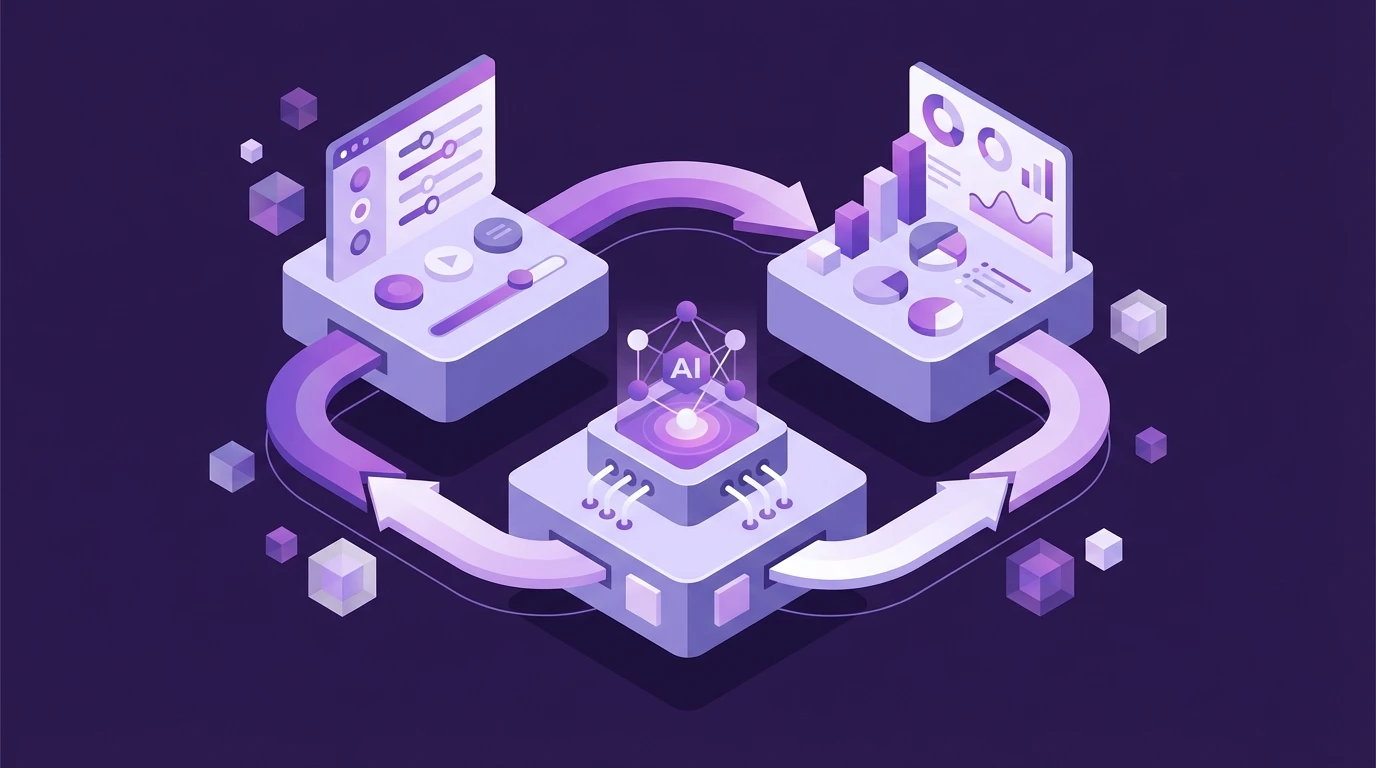
If you've used tools like Claude Code, Cursor, or GitHub Copilot's agent mode, you've already witnessed the agentic loop in action. It's the fundamental pattern that transforms a passive AI into an active problem solver.
Here's what makes it different from traditional AI interactions. Instead of generating one response and calling it done, an AI agent enters a continuous cycle. It thinks about the problem. It takes action. It observes the results. Then it loops back and does it again until the task is actually finished.
This pattern is why AI agents can now debug code across multiple files, research topics by consulting dozens of sources, or navigate complex workflows that would overwhelm a single prompt and response exchange.
Let's break down how this reasoning action loop actually works and why it matters for anyone building or using AI systems.
What Is the Agentic Loop?
The agentic loop is the operating cycle that allows AI agents to move beyond static automation. At its core, the agent loop pattern follows a simple structure:
Perceive → Reason → Act → Observe → Repeat
The agent takes in information from its environment. It thinks about what to do next. It takes an action. It observes what happened. Based on that observation, it decides whether to continue or stop.
This might sound straightforward. But the implications are significant.
Traditional AI operates on a single input and output model. You type a question, it generates an answer. Done. The model doesn't check if the answer is correct, doesn't gather additional information, and doesn't adapt based on what happened.
An iterative agent works differently. It can recognize when it needs more data. It can course-correct when something goes wrong. It can break complex goals into smaller steps and work through them systematically.
Think about how you'd actually pack for a trip. You might start by checking the weather forecast for your destination. Based on that information, you'd check your closet for appropriate clothes. If your warm jacket is at the dry cleaner, you'd adjust your approach and figure out what layers you can combine instead.
This is exactly how the agent cycle operates. Each observation informs the next thought, which drives the next action.
The Three Components: Think, Act, Observe
The think act observe pattern breaks down the agentic loop into three distinct phases that work together in a continuous cycle.
Think: The Reasoning Phase
During the thinking phase, the LLM component of the agent decides what step to take next. This isn't random. The agent evaluates its current context, considers what tools are available, and formulates a plan.
This phase is where chain-of-thought reasoning comes into play. The agent generates reasoning traces that help it work through the problem logically. It might think: "I need to find the current weather for New York. I have access to a weather API tool. I should call that tool with the location parameter."
The thinking component serves multiple purposes. It helps the agent decompose complex goals into manageable subtasks. It tracks progress toward the objective. It identifies when the approach needs to change. And it handles exceptions when things don't go as expected.
Act: The Execution Phase
Based on its reasoning, the agent takes action. This usually means calling a tool, whether that's searching the web, querying a database, executing code, or interacting with an API.
Actions are what separate agents from basic language models. While an LLM can only generate text, an agent equipped with tools can actually do things in the real world. It can read files, send messages, run tests, or retrieve information from external sources.
The action phase is where function calling becomes essential. The agent formats its request in a structured way that allows tools to execute properly. For example, it might generate a JSON command specifying which tool to call and what parameters to pass.
Observe: The Feedback Phase
After taking action, the agent receives feedback from the environment. This observation gets added to the agent's context, providing real-world data about what actually happened.
Did the API call succeed? What data came back? Was there an error message? The observation phase captures all of this information and feeds it back into the reasoning process.
This is where the magic happens. The agent doesn't just act blindly. It evaluates outcomes and uses that evaluation to inform what happens next. If an observation indicates an error or incomplete data, the agent can re-enter the cycle and try a different approach.
How ReAct Brought This Pattern to Life
The ReAct prompting technique formalized the think act observe loop for language models. Introduced by researchers at Princeton and Google in 2022, ReAct stands for Reasoning and Acting.
Before ReAct, reasoning and action in LLMs were studied as separate problems. Chain-of-thought prompting helped models reason step by step, but those models couldn't access external information to verify their reasoning. Action-focused approaches could use tools, but they struggled to plan coherently across multiple steps.
ReAct combined both capabilities. It showed that you could prompt an LLM to generate both verbal reasoning traces and task-specific actions in an interleaved manner.
Here's why this matters. Reasoning traces help the model track its progress and adjust plans on the fly. Actions allow the model to gather new information from external sources. When you combine them, you get agents that can handle exceptions, update their knowledge, and work through complex problems systematically.
The original ReAct research demonstrated significant improvements on question answering and decision making benchmarks. On HotpotQA, a challenging multi-hop reasoning task, ReAct agents overcame hallucination issues by verifying facts through external searches instead of relying solely on internal knowledge.
Implementing the Agentic Loop in Practice
Modern frameworks have operationalized the agentic loop into production-ready architectures. Understanding agent system architectures helps clarify how these implementations work.
LangGraph: Graph-Based Agent Loops
LangGraph represents agent workflows as directed graphs where nodes perform operations and edges determine flow. A typical tool-calling loop follows this structure:
Start → Agent LLM → Tools Decision → Tool Node → Agent LLM → ... → End
The agent node calls the language model. A conditional edge checks whether the LLM requested a tool call. If yes, flow continues to the tool node for execution. The tool's output goes back to the agent node for another reasoning cycle. If no tool call was made, the loop ends and the final response goes to the user.
This graph-based approach offers several advantages. You get clear checkpointing at each step, which enables debugging and human intervention. The structured execution makes it easier to implement features like persistence and streaming. And the visual representation helps teams understand complex agent behaviors.
The State Management Pattern
Central to any agent implementation is state management. The shared state object flows through the graph and stores all relevant information: messages, intermediate results, decision history, and tool outputs.
Short-term memory holds immediate context from the current task. Long-term memory stores accumulated experiences and lessons from past outcomes. Together, these memory systems allow agents to learn from what works and what doesn't.
This continuous state management is what enables multi-step reasoning systems to maintain coherence across complex workflows. Without it, every cycle would start from zero, forcing the agent to rediscover context each time.
Real-World Applications of the Agent Loop Pattern
The iterative agent pattern has proven especially valuable in domains that require exploration, refinement, and adaptation. Here are areas where the agent cycle delivers clear results.
Coding Assistants
Tools like Claude Code and Cursor implement the agentic loop to tackle programming tasks. The agent reads the codebase, identifies what needs to change, writes code, runs tests, analyzes failures, and iterates until the tests pass.
This mirrors how human developers actually work. You write code, run it, see what breaks, fix the issues, and repeat. The difference is that agents can maintain this cycle for hours across thousands of lines of code.
One developer recently used an agentic coding assistant to implement a complete flexbox layout algorithm in just three hours. The agent wrote around 800 lines of code and 350 tests through continuous iteration. A task that took a human developer two weeks in 2015 completed in a fraction of the time with the right feedback loop in place.
Research and Analysis
Deep research agents like those offered by OpenAI and Perplexity use multi-step reasoning loops to synthesize information from dozens of sources. The agent determines what questions need answering, searches for relevant information, evaluates what it finds, identifies gaps, and continues searching until it has comprehensive coverage.
These systems don't expect one-shot answers. They're designed to work through complex problems over multiple cycles, building understanding incrementally.
Customer Support
Support agents use the reasoning action loop to diagnose problems and deliver solutions. The agent gathers context from the customer, searches knowledge bases, checks account history, and synthesizes personalized responses. If the first approach doesn't resolve the issue, it can try alternative solutions.
Gartner predicts that by 2029, agentic AI will autonomously resolve 80% of common customer service issues without human intervention. That prediction depends entirely on agents that can iterate through troubleshooting steps rather than offering single-shot responses.
Workflow Automation
Workflow automation tools leverage agent loops to orchestrate complex business processes. An agent might need to retrieve data from multiple systems, transform that data, make decisions based on business rules, and take actions across different platforms.
Each step in the workflow feeds observations back to the agent, which determines what to do next based on the current state of the process.
The Challenge of Infinite Loops
Here's the uncomfortable truth about agentic systems: agents don't always know when to stop.
If you give an agent a vague goal or unclear success criteria, it can get stuck in cycles of attempted correction that never converge. It tries one approach, observes that it failed, tries again with a slight modification, fails again, and repeats indefinitely.
This isn't just a theoretical concern. Developers have reported agents burning through significant API costs trying to "improve" fixes until they break everything else. One practitioner described an agent that kept optimizing a fix until it made things worse.
Production systems need explicit safeguards:
Maximum iteration limits prevent runaway loops. Set a hard ceiling on how many cycles the agent can complete before it must stop or escalate.
Clear success criteria give the agent something concrete to evaluate. Not "optimize the database" but "reduce query time below 100ms." Not "fix the bug" but "make test_user_login pass."
Timeout mechanisms catch agents that spend too long on individual steps or the overall task.
Circuit breakers halt execution when patterns indicate the agent is stuck, such as repeating the same action multiple times with similar failure results.
Designing Effective Agentic Loops
The agentic design patterns that work best in production follow several principles.
Start Simple
Your first agent should do one thing, with one tool, with no loops. Get that working reliably before adding complexity. Every additional tool, decision branch, or iteration cycle introduces potential failure modes.
Make Tools Specific
Broad, flexible tools invite creative misuse. Instead of giving an agent generic capabilities like "execute any SQL query," create specific functions like "get_user_count" or "update_config_value."
The more constrained the tool, the harder it is for the agent to use it in unexpected ways.
Implement Observability
Without visibility into how an agent reasons and acts, you can't debug failures or optimize performance. Production agents need tracing that shows each thought, action, and observation in the cycle.
According to LangChain's State of AI Agents report, 89% of organizations with agents in production have implemented some form of observability. Among those with agents actively deployed, 71.5% have detailed tracing that allows inspection of individual agent steps.
Plan for Human Oversight
The most reliable agent architectures include self-reflection mechanisms and human-in-the-loop checkpoints. At critical decision points, the agent can pause for human review before proceeding.
This doesn't mean humans need to approve every action. But for high-stakes decisions or when the agent encounters uncertainty, human involvement provides a necessary safety net.
How Agent Planning Fits Into the Loop
The think phase doesn't just decide the immediate next step. Sophisticated agents engage in agent planning and reasoning that considers the entire path to the goal.
Plan-and-Execute is one architectural pattern that separates planning from execution. The agent creates a complete strategy upfront, outlining all the subtasks needed to reach the objective. Then it executes each step in sequence, using observations to verify that the plan is still valid.
This approach mirrors human project management: define goals, outline subtasks, execute in order. It works well when the problem structure is clear from the start.
The ReAct pattern takes a more incremental approach. Instead of planning everything upfront, the agent reasons about each step as it goes. This flexibility helps when the problem space is uncertain or when early observations significantly change what needs to happen next.
Many production systems combine both approaches. They start with a high-level plan but remain flexible enough to adapt the plan based on what they learn during execution.
Multi-Agent Loops: When One Isn't Enough
Some tasks benefit from multiple specialized agents working together, each running their own reasoning action loop while coordinating through shared state.
Consider a document quality improvement workflow:
A Writer Agent generates or refines a draft on a topic.
A Critic Agent reviews the draft, identifies weaknesses, and provides feedback.
The loop repeats until the Critic determines the quality meets the target standard.
This pattern appears in code review systems, content creation pipelines, and any process that benefits from distinct creation and evaluation phases.
Multi-agent orchestration introduces new challenges. Agents can deadlock when waiting for each other. Information can degrade as it passes between agents. Coordination overhead can slow the overall system.
For many use cases, a single well-designed agent with clear objectives outperforms complex multi-agent setups. Start simple and add agents only when you have clear evidence that specialization provides value.
The Difference Between Agent Loops and Simple Retries
A common question: how is an agent loop different from just retrying a failed operation?
The distinction matters. Simple retry mechanisms repeat the same action unchanged. If an API call fails, retry it. If it fails again, retry once more. The approach doesn't change.
Agent loops are adaptive. With each iteration, the agent incorporates new information and can modify its strategy. If the first approach fails, the agent reasons about why it failed and tries something different.
This adaptation is what makes agents effective for complex, open-ended tasks. They can explore solution spaces, recover from unexpected obstacles, and converge on working solutions through systematic iteration.
What Makes a Great Agent Loop?
The best implementations share several characteristics.
Transparency: Every cycle produces observable results. You can see what the agent tried, what it learned, and how its approach evolved. This audit trail is invaluable for debugging and for building trust with stakeholders.
Legibility: The reasoning process is exposed, not hidden. When the agent decides to take an action, the thought that led to that decision is captured and available for review.
Adaptability: The agent can handle uncertainty without breaking down. When conditions change or unexpected obstacles appear, it adjusts rather than failing.
Efficiency: Each iteration makes meaningful progress toward the goal. The agent avoids unnecessary cycles and recognizes when it has sufficient information to proceed.
If you want to go deeper on agent fundamentals, our complete guide to agents covers the broader landscape of what agents are and how they work.
What's Next for the Agentic Loop
The pattern continues to evolve. Current research explores several directions:
Adaptive reasoning depth adjusts how many cycles an agent runs based on task difficulty. Simple tasks complete quickly while complex problems get more iterations.
Dynamic pattern switching allows agents to change between reasoning modes depending on context. They might be reflective when uncertain but reactive when time-critical.
Improved termination detection helps agents recognize when they've achieved their goal or when further iteration won't help. Current systems struggle with this, often continuing longer than necessary or stopping too early.
Better failure recovery enables agents to recognize when they're stuck and try fundamentally different approaches rather than minor variations on the same failed strategy.
The agentic loop has already changed how we think about AI systems. It moved us from one-shot generation to iterative problem solving. As these patterns mature, agents will take on increasingly complex tasks with greater reliability.
Understanding the think, act, observe cycle isn't just academic. It's practical knowledge for anyone building, deploying, or using AI systems that need to do more than answer simple questions.