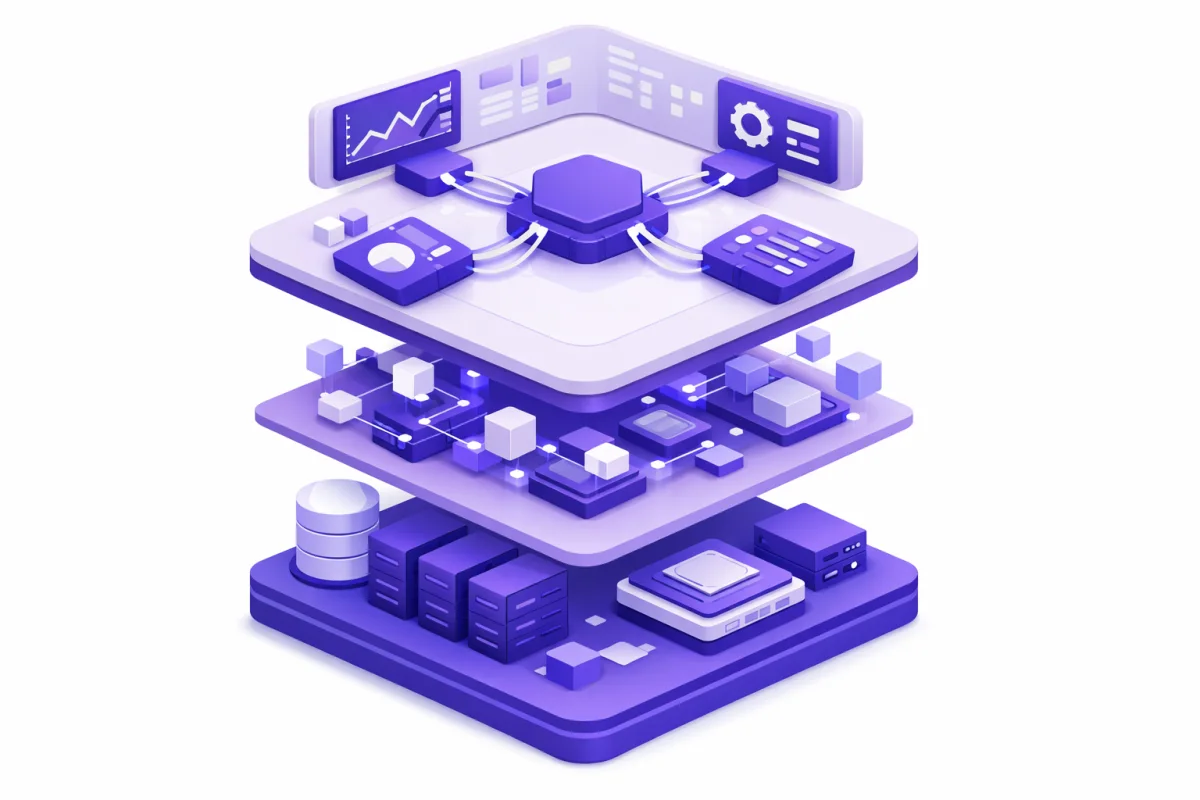
What Separates Real AI Agents from Basic Chatbots
Most people think AI agents are just fancy chatbots. They're not even close.
An AI agent architecture is what separates a chatbot that answers questions from a system that can research topics, write code, book appointments, and learn from its mistakes. It's the structural blueprint that determines whether your AI helper is genuinely useful or just an expensive autocomplete.
The AI agent market hit $7.6 billion in 2025 and is projected to grow at nearly 50% annually through 2033. That growth isn't happening because companies want fancier chatbots. It's happening because properly architected agents can actually do things autonomously.
In this guide, you'll learn exactly how agent system design works, from the foundational components to advanced multi-agent orchestration patterns. Whether you're building your first agent or optimizing an existing system, understanding architecture is what separates agents that scale from expensive experiments.
What Is AI Agent Architecture?
AI agent architecture refers to the internal structure that allows agents to observe their environment, think about what to do, take action, and learn from the results. It's the framework that connects all the moving pieces: how an agent processes inputs, stores memories, makes decisions, executes tasks, and improves over time.
Think of it like the difference between a calculator and a human accountant. A calculator does exactly what you tell it. An accountant observes the situation, remembers past contexts, plans an approach, executes the work, and adjusts based on what they learn. Agent architecture is what gives AI that accountant-like capability.
Understanding intelligent agent foundations helps clarify why architecture matters. Without proper structure, agents struggle when inputs shift or data is incomplete. With robust architecture, they adapt and scale.
The traditional agent model followed a simple loop: Perceive, Decide, Act, Learn. Modern AI agent architecture has evolved into something more flexible. Today's agents use a Trigger, Plan, Tools, Memory, Output flow that allows for adaptation, replanning, and escalation based on outcomes.
Core Agent Components That Make Everything Work
Every functional AI agent relies on a set of components working together. These agent components aren't optional add-ons. They're fundamental to how agents operate across different tasks.
Perception Module
The perception module is how an agent "sees" and interprets its environment. Whether processing text, audio, images, or structured data, this component translates raw input into information that other modules can act on. Modern agents handle multimodal inputs, meaning they can process a screenshot, read a PDF, and understand voice commands all within the same workflow.
Decision-Making Engine
This is where the actual reasoning happens. The decision-making engine analyzes information gathered from perception, retrieves relevant memories, and determines the best course of action. Large language models like GPT-5.2, Claude Opus 4.5, and Gemini 3 Pro power most modern decision engines. Each excels in different areas: Claude leads in coding tasks, Gemini dominates complex reasoning, and GPT-5.2 balances speed with capability.
Memory Systems
Memory is what transforms a stateless chatbot into a contextual assistant. There are several types:
Short-term memory holds the active context for the current task. It's what lets an agent remember what you said five messages ago without asking again.
Long-term memory stores information across sessions. This includes episodic memory (specific past events and interactions), semantic memory (general knowledge and facts), and procedural memory (learned skills and processes).
Dive deeper into memory in agent systems to understand how this works technically.
Planning Module
Complex tasks require breaking goals into actionable steps. The planning module decomposes high-level objectives into sequences of subtasks, identifies dependencies, and creates execution roadmaps. For more on how agents handle this, explore agent planning mechanisms.
Action Executor
Planning is useless without execution. The action executor takes planned steps and actually does things: calling APIs, generating content, running code, or triggering workflows. This component handles errors, manages retries, and escalates when necessary.
Tool Integration Layer
Modern agents extend their capabilities through external tools. This layer manages connections to databases, web services, file systems, and third-party APIs. The tool use and function calling paradigm has become central to agent capability expansion.
How the Think, Act, Observe Loop Actually Works
The think act observe loop is the heartbeat of agent operation. Understanding this cycle is essential for anyone working with agent system design.
Here's how it flows:
The agent receives a trigger, maybe a user message, an API call, or a scheduled event. It then enters a reasoning phase where it thinks about what needs to happen. Based on that reasoning, it takes an action, perhaps calling a tool or generating output. It observes the result of that action. Then it reasons again about what to do next.
This loop continues until the agent reaches its goal or determines it needs human input.
What makes this powerful is the interleaving of thought and action. Unlike a rigid script that plans everything upfront and executes blindly, the think-act-observe loop adapts on the fly. If a tool call fails, the agent doesn't crash. It observes the failure, thinks about alternatives, and tries something different.
Design Patterns That Shape Agent Behavior
Design patterns are the blueprints that define how agents approach problem-solving. Each pattern has tradeoffs around speed, cost, reliability, and complexity. Learning about agentic design patterns helps you choose the right approach for specific use cases.
ReAct (Reasoning and Acting)
ReAct combines chain-of-thought reasoning with iterative action. Instead of generating a direct answer, a ReAct agent thinks step-by-step and performs intermediate actions (like searches or calculations) before finalizing its answer.
The pattern works like this: Thought, Action, Observation, repeat until done.
For example, if asked "What's Tesla's stock price compared to Ford's?", a ReAct agent would think "I need Tesla's price first," search for it, observe the result, think "Now I need Ford's price," search again, observe, then synthesize the final answer.
ReAct trades speed for thoughtfulness. Each reasoning loop requires additional model calls, increasing latency and cost. But the transparency makes debugging faster and builds trust in agent decisions.
Reflection Pattern
The agent reflection patterns approach adds a self-evaluation layer. The agent generates an initial response, then explicitly critiques its own work. It checks for accuracy, verifies constraints, and identifies gaps. Based on that critique, it generates an improved version.
This works like having an editor review your draft before publishing. The reflection cycle catches errors that would otherwise slip through.
The tradeoff? Each reflection cycle increases token consumption and latency. Without well-defined exit conditions, agents can loop unnecessarily. You need specific, measurable critique criteria, or you'll waste resources on revisions that don't actually improve quality.
Planning Pattern
Planning agents decompose complex tasks into structured roadmaps before execution begins. Rather than attempting to solve problems directly, they first analyze requirements, identify dependencies between subtasks, and sequence operations logically.
Think of it like building IKEA furniture. You don't just start screwing random pieces together. You lay out all the parts, read the instructions, understand the sequence, and then begin assembly.
Planning patterns shine for multi-step tasks where order matters and dependencies exist between steps.
Tool Use Pattern
Tool use extends agent capabilities beyond pure text generation. Agents can search the web, run calculations, access databases, generate images, or interact with any API.
What makes tool use powerful is dynamic selection. The agent doesn't follow a predetermined script. If one search doesn't return adequate information, it reformulates the query. If an API call fails, it tries alternatives. This adaptability separates capable agents from rigid automation.
The Model Context Protocol Revolution
The Model Context Protocol (MCP) has become the de facto standard for connecting agents to tools and data sources. Introduced by Anthropic in late 2024 and donated to the Linux Foundation's Agentic AI Foundation in December 2025, MCP solves a fundamental problem: before MCP, integrating an AI agent with each data source required custom one-off solutions.
MCP provides a universal interface for reading files, executing functions, and handling contextual prompts. Think of it as USB-C for AI agents. One standard that works everywhere.
Since its launch, the community has built thousands of MCP servers for popular platforms. SDKs exist for all major programming languages. Companies like Microsoft, OpenAI, and Google have adopted MCP, and Google launched managed MCP servers for services like Maps and BigQuery.
The practical impact? If you build your agent with MCP client support, you immediately unlock access to an entire ecosystem of existing integrations without extra coding. Your agent can connect to Google Drive, Salesforce, databases, and hundreds of other systems through standardized interfaces.
For developers wanting to understand these connections better, our complete AI agents guide covers the technical implementation details.
Single Agent vs Multi-Agent Architectures
Not every task needs multiple agents. But complex workflows often benefit from specialized collaboration.
Single Agent Architecture
A single agent handles everything: perception, reasoning, action, tool use. This works well for focused tasks where the context fits within one model's capabilities. Single agents are simpler to build, debug, and maintain.
The limitation? As you add more tools and increase task complexity, performance degrades. You'll see increased latency, incorrect tool selection, or outright failures. There are different types of AI agent systems optimized for different scopes of work.
Multi-Agent Architecture
Multi-agent systems split work across specialized agents, each optimized for specific domains. One agent handles research, another handles writing, a third handles editing. They communicate, share context, and collaborate toward shared goals.
This mirrors how human teams work. You don't have one person doing sales, engineering, legal review, and customer support. You have specialists coordinated by management.
Several orchestration patterns exist:
Supervisor Pattern: A central orchestrator receives tasks, breaks them into subtasks, delegates to specialist workers, monitors progress, and synthesizes final outputs. Best for complex workflows where transparency and quality assurance matter more than raw speed.
Hierarchical Orchestration: Multiple layers of supervisors and workers, like a corporate org chart. Enables complex organizational structures with delegation chains and team-level decision making.
Decentralized Swarms: Agents negotiate and self-organize without central control, similar to ant colonies. Useful when real-time responsiveness matters and tasks can be parallelized.
The comparing agent frameworks resource breaks down how different platforms implement these patterns.
Agent Framework Architecture in 2026
The framework landscape has matured significantly. Three years ago, picking an agent framework meant navigating chaos. In 2026, clear winners have emerged for different use cases.
LangGraph
LangGraph leads for complex, stateful multi-agent workflows. Its graph-based architecture handles branching, cycles, and conditional logic with explicit state management. Agents are represented as nodes that maintain their own state, connected through directed graphs.
Best for: Enterprise workflows requiring reliability, production-grade traceability, and fine-grained orchestration.
CrewAI
CrewAI focuses on role-based agent teams. You define agents with specific roles (Researcher, Writer, Editor), and the framework handles task delegation and inter-agent communication. Its architecture prioritizes rapid prototyping.
Best for: Marketing automation, content pipelines, and scenarios where agents have clearly defined responsibilities.
Microsoft Agent Framework
Microsoft merged AutoGen and Semantic Kernel into a unified framework with production SLAs, multi-language support (C#, Python, Java), and deep Azure integration. General availability launched in Q1 2026.
Best for: Enterprise teams in the Microsoft ecosystem who need formal support contracts and compliance guarantees.
Google Agent Development Kit (ADK)
Google's ADK integrates with Gemini and Vertex AI. It supports hierarchical agent compositions and requires minimal code for efficient development.
Best for: Teams already invested in Google Cloud who want native ecosystem integration.
Understanding neural network fundamentals helps when evaluating which models and frameworks suit your technical requirements.
Building Agent Systems: A Practical Framework
If you're building agent systems from scratch, here's a practical approach that balances capability with complexity.
Start Simple
Begin with a single agent using the ReAct pattern. Add tools incrementally. Don't jump to multi-agent orchestration until you've hit clear limitations with a single agent.
The expensive mistake is over-engineering from day one. Multi-agent systems are impressive, but single agents with ReAct and appropriate tools handle most real-world tasks effectively.
Add Reflection for Quality-Critical Tasks
When mistakes are costly, add reflection loops. The extra latency and token costs are worth it for applications in compliance, finance, healthcare, or any domain where errors have real consequences.
Scale to Multi-Agent When Needed
Move to multi-agent architectures when tasks are naturally separable and parallel, when different roles need distinct prompts or tools, or when single-agent complexity becomes unmanageable.
Signs you need multi-agent:
- Task requires expertise across multiple domains
- Workflow has natural handoff points
- Quality suffers from context overload
- You need different reliability levels for different steps
Choose Orchestration Patterns Based on Priorities
Supervisor patterns when transparency and control matter most. Hierarchical when you have complex team structures. Decentralized when speed and parallel execution are critical.
Ready to find the right tool for building agents? Browse our AI tools directory to explore frameworks, platforms, and agent builder platforms that match your technical requirements.
What Makes Agent Architecture Production-Ready?
Research prototypes and production systems have different requirements. These factors separate agents that work in demos from agents that work at scale.
Error Handling and Recovery
Production agents need mechanisms to retry failed operations, route to alternative approaches, or gracefully degrade when things go wrong. This isn't optional. Real-world systems encounter API failures, rate limits, malformed inputs, and edge cases constantly.
State Management
Long-running tasks need persistent state. If an agent crashes mid-workflow, can it resume? Frameworks like LangGraph and Temporal provide durability primitives that let agents pause, resume, and recover.
Observability
You need to see what agents are doing. Audit logs, performance metrics, and tracing are essential for debugging, compliance, and optimization. LangSmith, AgentOps, and similar tools provide this visibility.
Human-in-the-Loop
For high-stakes decisions, agents should escalate to humans rather than acting autonomously. Building approval workflows, confidence thresholds, and escalation triggers keeps agents safe and trustworthy.
Security and Access Control
Agents with tool access can do damage. Role-based permissions, sandboxing for risky operations, and secure credential management are non-negotiable for enterprise deployment.
Common Architecture Mistakes and How to Avoid Them
Overloading Context Windows
Stuffing everything into the prompt seems convenient but degrades performance. Use memory systems to store and retrieve relevant context selectively rather than dumping entire histories into every request.
Ignoring Latency Costs
Each tool call, reflection loop, or multi-agent handoff adds latency. Map your workflows and identify bottlenecks. Sometimes a less sophisticated approach that runs faster delivers better user experience.
Treating All Tasks as Agent Problems
Not everything needs an agent. Simple automation, rule-based workflows, and traditional APIs often work better for predictable, well-defined tasks. Reserve agent architecture for situations requiring reasoning, adaptation, or natural language understanding.
Skipping Evaluation
Without measurements, you're guessing. Track success rates, latency distributions, token costs, and user satisfaction. Run evaluation suites regularly and catch regressions before they hit production.
The Future of Agent Architecture
Several trends are shaping where agent architecture heads next.
Specialization Over Generalization
Models are increasingly optimizing for specific use cases. Claude for coding, Gemini for reasoning, Grok for real-time information. Agent architectures will leverage multiple specialized models rather than relying on one general-purpose system.
Standardization Through Protocols
MCP adoption is accelerating. The Agentic AI Foundation under the Linux Foundation is driving vendor-agnostic standards for tool connectivity, agent communication, and interoperability. Expect this standardization to make building and connecting agents significantly easier.
Enterprise Focus
The agent conversation is shifting from "can we build this?" to "how do we govern this?" Enterprise requirements around compliance, auditability, and control are driving architectural decisions. Frameworks are adding features for policy enforcement, access control, and human oversight.
Efficiency Improvements
Running agents is expensive. Code execution patterns that minimize token usage, smarter context management, and efficient multi-model routing will become standard. Architectures that optimize cost per task will win in production environments.
Wrapping Up
AI agent architecture isn't just a technical curiosity. It's the foundation that determines whether your AI investments actually pay off.
The core principles are straightforward: clear component separation, appropriate design patterns, scalable memory systems, robust tool integration, and governance that keeps things safe. The implementation details vary based on your specific needs, existing infrastructure, and risk tolerance.
Start with the simplest architecture that could work. Add complexity only when you hit clear limitations. Measure everything. And remember that the goal isn't the most impressive architecture on paper, but agents that reliably solve real problems.