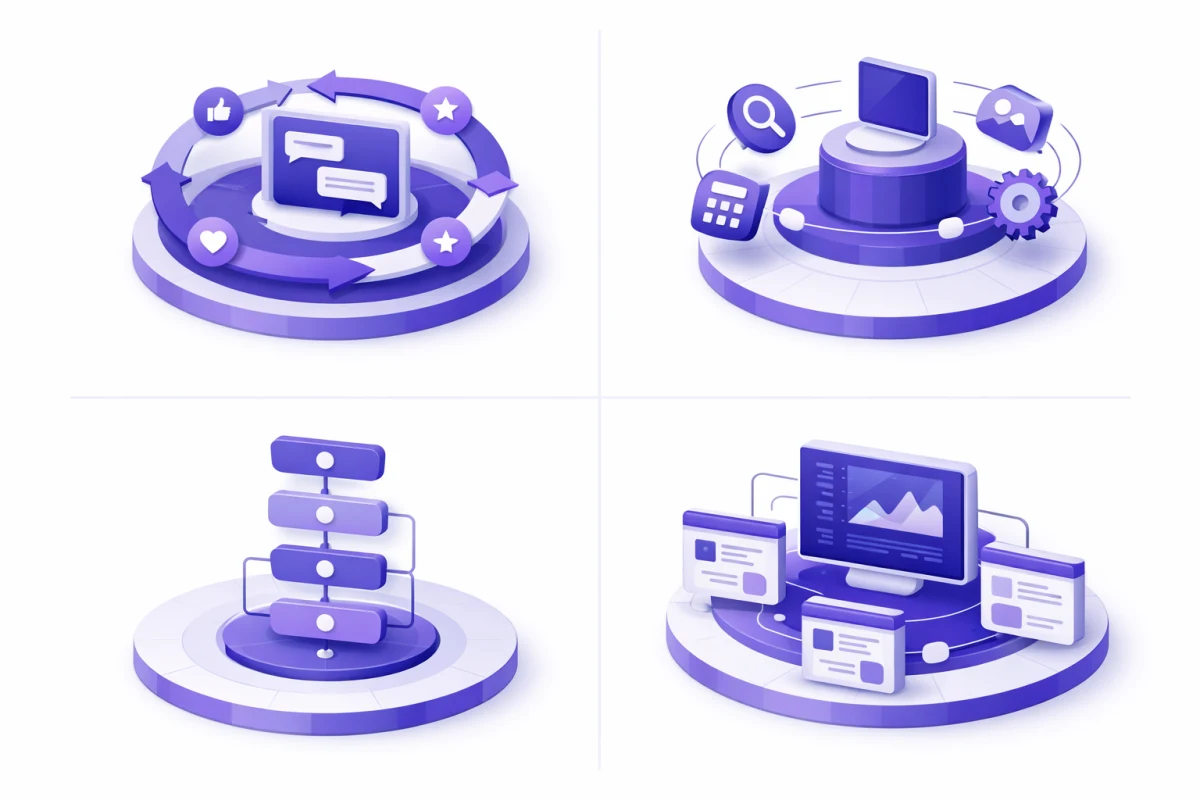
AI agents are only as good as the patterns they're built on. And right now, four agentic design patterns are shaping how the most capable autonomous systems work: Reflection, Tool Use, Planning, and Multi-Agent Collaboration.
AI researcher Andrew Ng popularized these patterns as the core blueprints for building agents that can reason, act, and improve their outputs. Understanding them is essential if you're building, deploying, or just following where AI is headed in 2026.
If you want the full picture first, our comprehensive agentic AI guide covers the broader ecosystem. But here we're going deep on the four patterns themselves.
What Are Agentic Design Patterns?
An agent pattern is a reusable approach to solving a specific type of problem in agentic systems. Think of them like architectural patterns in software engineering. They don't tell you what to build; they tell you how to structure the building.
The four common agent patterns that Ng described work at the level of how an agent reasons, what resources it can access, how it structures its work, and how it collaborates with other agents. They're not mutually exclusive. In production, you'll typically see two or three combined into a single system.
Before breaking down each one, it helps to understand what agentic AI actually means and why standard LLM calls fall short for complex, multi-step tasks.
Pattern 1: Reflection
Reflection is the simplest of the four patterns, and often the most immediately impactful. The idea: you have an agent review and critique its own output before finalizing it.
Here's how it works. The agent generates an initial response. It then switches into critic mode, checking for accuracy, logical gaps, and constraint violations. If problems are found, it revises. This loop continues until the output meets a quality threshold.
You can make reflection more powerful by giving the agent tools. Run the code it writes and check for errors. Search the web to verify its claims. Use another LLM instance as the critic. That last approach, where two separate agent personas go back and forth, tends to produce noticeably better results than single-agent self-critique.
The main tradeoff is token cost and latency. Each reflection cycle adds compute. Without clear exit conditions, you can end up in loops that consume resources without meaningfully improving output. The fix is to define explicit quality criteria upfront and cap the number of revision passes.
Pattern 2: Tool Use
Tool Use is what turns an LLM from a text generator into an agent that can actually do things. Without tools, an agent is working from static training data. With them, it can query live databases, call APIs, run code, send emails, and interact with external systems.
The ai agent design here is straightforward: the LLM decides which tool to use, constructs the appropriate call, receives the output, and uses that result in its next reasoning step. This cycle can repeat multiple times within a single task.
Protocols like the Model Context Protocol (MCP) have made tool integration much cleaner in 2026. Instead of custom function definitions for every tool, MCP provides a standardized interface that agents can discover and call dynamically.
Tool Use is a strong fit for customer support, document processing, and any task where the correct answer depends on current data rather than training knowledge. It's also foundational to implementing agentic workflows effectively in real production environments.
Pattern 3: Planning
Planning agents don't jump straight into execution. They first analyze the task, identify the sub-steps needed, sequence those steps in order, and then start executing with awareness of where they are in the overall plan.
The most effective version of planning uses what's called Interleaved Decomposition. Rather than generating a rigid plan and sticking to it, the agent plans one step, executes, reflects on the result, and adjusts the next step based on what it learned. This makes the pattern adaptive to dynamic environments where conditions change mid-task.
Planning is what enables agents to handle tasks that span minutes, hours, or even days. A research agent might need to search multiple sources, synthesize findings, identify gaps, run additional searches, and then write a report. Without a planning layer, it would lose track of where it is in the process.
Good agent orchestration strategies almost always include planning as a core component. The orchestrator uses a planning pattern to decompose the overall goal, then assigns sub-tasks to worker agents.
One practical issue: LLMs sometimes over-plan. They generate elaborate multi-step sequences for tasks that only need two or three steps. Prompt design matters here. Clear constraints on planning depth help keep agents focused.
Pattern 4: Multi-Agent Collaboration
The Multi-Agent Collaboration pattern treats agent systems like teams. Instead of one generalist agent trying to do everything, you build specialized agents and coordinate them to work together.
A typical setup has an orchestrator agent that receives the top-level goal, breaks it into tasks, assigns each to a specialist, and then synthesizes the results. The specialists might include a research agent, a writing agent, a code review agent, and a fact-checking agent. Each is prompted and tuned for its specific role.
Research on multi-agent system architectures shows this approach consistently outperforms single-agent setups on complex tasks. The tradeoff is coordination overhead. Multi-agent systems are harder to debug because you don't always know in advance what the agents will do or how they'll interact.
When choosing a framework comparison for agents, multi-agent support is now a key criterion. LangChain, CrewAI, and AutoGen all take different approaches to orchestration and agent communication.
The pattern scales well when tasks have clear modularity. If you can cleanly separate the sub-problems, each specialist can work in parallel, which also reduces total latency.
How the Patterns Work Together
Real-world agent systems rarely use a single pattern in isolation. A production research agent might use Planning to decompose the task, Tool Use to search the web and query databases, Reflection within each step to verify findings, and Multi-Agent Collaboration where specialized sub-agents handle different domains.
Start with the simplest combination that addresses your core problem. Add patterns only when a specific failure mode demands it. Reflection handles output quality problems. Tool Use handles knowledge gaps. Planning handles task complexity. Multi-Agent handles specialization at scale.
Building stateful agent systems with LangGraph is one approach that naturally combines planning and reflection, maintaining explicit state between steps so the agent knows what it's done and what comes next.
Which Pattern Should You Start With?
If you're new to agentic AI, start with Reflection. It's the easiest to implement, requires no external integrations, and produces immediate, measurable improvements in output quality. Just add a second LLM call that reviews the first output, and you're running a basic reflection loop.
Tool Use comes next. Pick one external tool your use case actually needs, integrate it, and build from there. Planning and Multi-Agent Collaboration are more complex and pay off most on longer-horizon, multi-step tasks.
You don't have to build from scratch. There are purpose-built tools to build AI agents that implement these patterns out of the box, so you can focus on your specific workflow rather than the infrastructure.
To see how these patterns in action examples play out across industries, the follow-up article on agentic AI use cases breaks down how businesses are applying each pattern in production today.
If you want to explore the full range of agent capabilities and find tools that fit your stack, browse the ai agents marketplace to discover options across every category.
Why These Patterns Matter in 2026
In 2025, agentic design patterns were still largely theoretical for most teams. In 2026, they're becoming production requirements. Companies that can't build reliable agent systems around these patterns are falling behind on automation speed and output quality.
The shift isn't about bigger models. GPT-4-class performance in an iterative agentic workflow consistently outperforms the same model in a single-shot setting. The agent architecture patterns matter more than the base model for most real-world tasks.
These four patterns give you the vocabulary and the structure to build agents that don't just generate text but actually accomplish goals.