Introduction
Artificial intelligence (AI) has become a driving force in modern technology, reshaping industries and introducing solutions that once seemed futuristic. From AI-driven recommendation engines that tailor product suggestions to advanced robotics managing warehouse operations, the concept of AI agents underpins these innovations. But what makes an AI agent distinct from standard software, and how do we categorize its evolving capabilities?
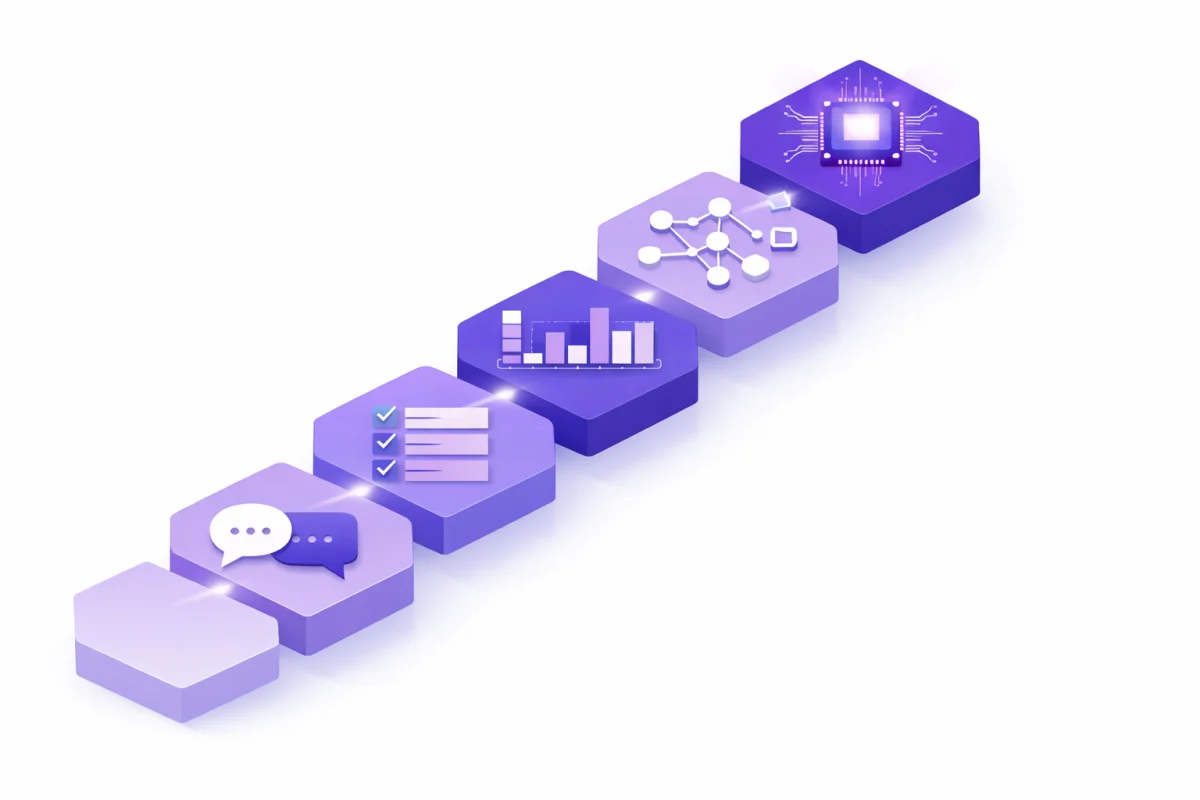
One useful framework is the “levels of AI agents,” which charts the path from simple, rule-based programs to highly sophisticated systems that might one day surpass human cognitive abilities. Appreciating these levels clarifies how agents develop from reactive tools to adaptive, goal-oriented partners capable of complex tasks. In this blog, we’ll traverse each of the seven levels, outlining key traits, practical uses, and likely future directions. By the end, you’ll be equipped to assess which AI approaches align best with your organizational needs or personal projects.
The Evolution of AI Agents in the Digital Age
Defining AI Agents and Their Role in Technology
AI agents are autonomous software entities that perceive their surroundings, make decisions, and take actions to achieve specified objectives through contextual understanding. Unlike traditional applications that merely follow hardcoded instructions, autonomous AI agents can use learning and optimization to improve their responses over time. This dynamic approach positions them as crucial drivers in fields like customer service, healthcare, finance, and logistics.
An AI agent’s core strength is its ability to operate continuously, often making split-second judgments without human intervention. Whether it’s a chatbot providing immediate answers or a manufacturing agent adjusting machinery based on sensor data, the technology amplifies efficiency. The agent’s capacity for learning allows it to refine strategies, evolving from simple rule-based patterns to more nuanced, data-driven insights.
The Historical Progression and Future of AI Agents
Early AI systems revolved around predefined rules (expert systems), limited by an inability to adapt. The advent of machine learning enabled algorithms to extract patterns from large datasets, boosting accuracy in tasks like image recognition. More recently, large language models (LLMs) like OpenAI's Claude and those by Google have broadened capabilities in text-based interactions, paving the way for AI agents that engage in more natural dialogues.
Research now focuses on collaboration among multiple agents, advanced decision-making processes, and real time adaptability. As computing power and data availability grow, so does the potential for higher levels of autonomy. Though super-intelligent AI agents remain speculative, each milestone in hardware and algorithms nudges us closer to systems that can tackle increasingly complex challenges with minimal human guidance.
Level 1—Reactive Agents
Operating Based on Immediate Inputs
Reactive agents are the simplest AI form, acting solely on current stimuli. They rely on condition-action rules and have no memory of past events. A basic thermostat exemplifies this level: it checks the temperature and adjusts heating or cooling without referencing specific inputs or prior states. While reliable for stable, repetitive tasks, reactive agents struggle with any shift outside their programming.
In business, these agents handle straightforward duties—security alerts or basic customer service chatbots that respond to keywords with transparency. Their strength is speed and simplicity, but the absence of learning mechanisms restricts them to narrow pathways and contexts. For firms with highly predictable workflows, reactive agents can be a cost-effective choice, yet they can’t adapt to evolving conditions or user preferences.
Level 2—Task-Focused Agents
Excelling in a Specific Function
Task-focused agents extend reactivity by incorporating short-term memory. They observe recent inputs, update an internal model, and refine actions accordingly. A spam filter that “remembers” flagged emails is a perfect illustration. It compares incoming messages to stored examples, adjusting thresholds or rules to enhance accuracy.
This ability to adapt within a defined scope allows level 2 agents to excel in navigation apps, personalized recommendations, or limited customer support contexts. They can handle modest variability, but their domain knowledge remains narrow. If a spam filter is thrust into a domain for which it wasn’t trained, it fails to generalize effectively. Nonetheless, task-focused agents are widely deployed for repetitive, data-intensive problems where incremental learning offers tangible benefits.
Level 3—Context-Aware Agents
Managing Uncertainty and Complex Scenarios
Context-aware agents employ goal-oriented reasoning and can handle more complex tasks. They weigh multiple strategies to achieve set objectives, adapting to new data or altered constraints. A scheduling AI might balance time zones, participant availability, and room resources to produce optimal meeting times. If circumstances change—like a last-minute cancellation—it recalibrates.
Such agents leverage methods like reinforcement learning, searching for actions that maximize success over time. They’re ideal for dynamic pricing, resource allocation, and certain forms of game playing, where strategic planning is essential, much like analyzing traffic patterns. Yet, context-aware agents generally remain domain-specific. They excel within their realm but may not transfer their planning prowess to unrelated tasks.
Level 4—Socially Intelligent Agents
Interpreting and Responding to Human Behavior
Social intelligence enters the picture at level 4. These agents can interpret tone, sentiment, and other social cues, often using large language models for sophisticated natural language processing. Rather than just answering queries, they sense user intent or emotion, adjusting their responses. A virtual health assistant might detect stress and respond empathetically, or a customer service chatbot could escalate a conversation if it detects frustration. Additionally, incorporating sentiment analysis can enhance their ability to understand and respond to user emotions effectively.
By blending context awareness with social understanding, level 4 agents deliver richer, more intuitive user experiences. They’re especially helpful in personalized education, mental health support, and high-touch customer service. However, their ability to interact socially doesn’t imply full domain mastery elsewhere, as they still depend on specialized training data and algorithms aligned with particular tasks despite the inherent ambiguity in dynamic environments.
Level 5—Self-Reflective Agents
Gaining Awareness and Enhancing Performance
Self-reflective agents bring metacognition into the mix. They can evaluate their methods, identify errors, and refine approaches to improve performance. without human input. Instead of just learning from external data, they also learn from their own decision-making processes. This allows them to detect inefficiencies, try new strategies, or even collaborate with other agents to share insights, enhancing their meta-analysis skills.
Consider a group of warehouse robots coordinating item retrieval. Each robot monitors its performance—how quickly it finds items, how often it chooses suboptimal routes—and shares that data with its peers. Over time, they all learn to streamline tasks collectively. This self-reflection can yield substantial gains in efficiency while reducing the need for constant human supervision.
Level 6—Generalized Intelligence Agents
Functioning Across Multiple Domains
Level 6 agents boast generalized intelligence, capable of transferring knowledge across tasks. An agent trained to analyze financial data could apply its skills to marketing analytics without extensive retraining. This flexibility arises from advanced machine learning architectures that capture broad patterns, enabling quick adaptation.
Such versatility positions these agents as valuable all-rounders. They might serve as multifaceted digital assistants, handle diverse operational tasks, or drive big-picture analytics across various departments. While genuine generality is rare—most AI still performs best with domain-specific tuning—level 6 represents a meaningful stride toward an agent that can tackle multiple real time challenges.
Level 7—Super Intelligent Agents
Surpassing Human-Level Intelligence
Level 7 embodies the concept of super intelligence: AI that outperforms human capability in virtually every respect. Although speculative, this vision raises complex questions. How do we ensure alignment with human ethics and values? Could such an AI make autonomous decisions with unpredictable outcomes? Researchers are split on whether super intelligence is near or decades away, but the notion underscores the need for responsible AI governance.
As a theoretical endgame, super intelligent agents symbolize both extraordinary opportunity—solving issues like climate change or disease eradication—and potential existential risks. For now, these agents remain a topic for future speculation rather than practical deployment. Yet the prospect shapes how we think about long-term AI safety and ethics.
Conclusion
The seven levels of AI agents mark a clear progression in memory, learning, and problem-solving. From basic reactive agents (level 1) to the theoretical super intelligence (level 7), each stage adds adaptability and sophistication. Understanding these tiers helps you align AI capabilities with your needs, avoiding unnecessary complexity while maximizing efficiency.
As AI advances, different agent levels will coexist, with simpler agents handling repetitive tasks and higher-level ones managing strategy and communication. This structured integration optimizes resources and ensures operational continuity, especially in large enterprises. Emerging research in multi-agent systems will further blur these distinctions, driving AI toward seamless collaboration and innovation.
Looking ahead, AI agents will expand their roles in industries like supply chain, healthcare, and sustainability. By combining different levels—such as self-reflective agents for logistics and socially intelligent agents for regulatory compliance—organizations can enhance decision-making, reduce costs, and boost resilience.
Ultimately, selecting the right AI agent depends on your goals. Reactive agents suit stable tasks, while self-reflective or generalized agents excel in dynamic environments. A strategic approach ensures AI solutions that are both practical and forward-looking.
FAQ:
How do AI agents differ in capabilities across various levels?
They vary in memory, learning depth, and decision-making scope. Reactive agents (level 1) respond solely to immediate conditions, while task-focused agents (level 2) add limited memory. Context-aware agents (level 3) plan toward specific objectives, and socially intelligent agents (level 4) engage users with empathy or tailored dialogue. At level 5, self-reflection lets agents assess their methods and improve, while level 6 generalizes across multiple domains. Level 7 transcends human intelligence, remaining a theoretical construct.
What tasks can be performed by AI agents at different levels?
- Level 1 (Reactive): Simple rule-based actions like switching devices on/off or basic chat responses.
- Level 2 (Task-Focused): Spam filtering, targeted product recommendations, or basic anomaly detection.
- Level 3 (Context-Aware): Dynamic scheduling, resource optimization, or strategic game-playing.
- Level 4 (Socially Intelligent): Personalized customer service, empathetic chatbots, and advanced dialogue systems.
- Level 5 (Self-Reflective): Multi-robot coordination, logistics management, and continuous self-improvement tasks.
- Level 6 (Generalized Intelligence): Cross-domain data analysis, versatile digital assistants, and adaptive enterprise automation.
- Level 7 (Super Intelligent): Hypothetical capabilities surpassing human-level expertise in nearly every domain.
Are there limitations to the abilities of AI agents based on their levels?
Yes. Reactive agents lack any adaptability, making them brittle in changing environments. Task-focused agents do learn but remain confined to one domain. Context-aware agents still depend on clear goals, which can limit their utility in entirely novel scenarios. Socially intelligent agents might misinterpret complex human cues, and self-reflective agents require robust self-monitoring frameworks that can be challenging to implement. Generalized agents, while flexible, need vast and diverse training data and may not achieve full human-like versatility. Super intelligent AI raises ethical and control issues, with no current practical examples of its deployment.
How do AI agents progress from one level to another?
Progress typically involves added memory structures, more advanced learning algorithms, and broader domain capabilities. Moving from reactive to task-focused means introducing a short-term memory model. Upgrading to context-aware requires goal-oriented strategies, often enabled by reinforcement learning. Social intelligence involves advanced natural language processing and emotional analysis, and self-reflection demands internal performance reviews. For generalized intelligence, knowledge transfer across tasks is key. The leap to super intelligence remains speculative, hinging on breakthroughs in machine consciousness or self-directed evolution.
What are the criteria for determining the level of an AI agent?
Several factors guide classification:
- Memory Usage: Does the agent store past inputs or states?
- Learning Mechanism: Is it rule-based, data-driven, or self-reflective?
- Goal Orientation: Does it simply react, or does it strategize to achieve objectives?
- Social Awareness: Can it interpret user emotions or context?
- Domain Breadth: Is it specialized or can it transfer skills across domains?
- Collaboration: Does it coordinate tasks with other agents?
- Autonomy: How much human intervention is required?
- Self-Evaluation: Can it critique and refine its own performance?
By assessing these criteria, you can place an AI system along the spectrum of reactive, task-focused, context-aw
Can AI agents interact with each other effectively at different levels?
Yes, AI agents can interact effectively at different levels. Higher-level agents can understand and collaborate with lower-level agents, but the efficiency of interactions may vary depending on the levels of complexity and capabilities of the agents involved in the interaction.
are, socially intelligent, self-reflective, generalized, or hypothetically super intelligent. This framework clarifies which features matter most for your intended application, informing more effective AI deployments.