What Is RAG and Why Should You Care?
So what is RAG, exactly? Retrieval Augmented Generation is a technique that makes AI language models smarter by giving them access to external information when they answer questions. Instead of relying only on what they learned during training, RAG-powered systems fetch relevant documents from a knowledge base before generating responses.
Think of it like the difference between asking someone to answer from memory versus letting them look things up first. The second approach tends to be more accurate.
The term was coined in a 2020 research paper by Patrick Lewis and colleagues at Meta AI. Lewis later joked that they would have picked a better name if they knew how widely adopted it would become. Regardless of the awkward acronym, RAG has become foundational for enterprise AI applications.
Here's why this matters. Standard LLMs have a knowledge cutoff date. They don't know anything that happened after their training ended, and they can't access your company's internal documents or proprietary data. RAG solves both problems.
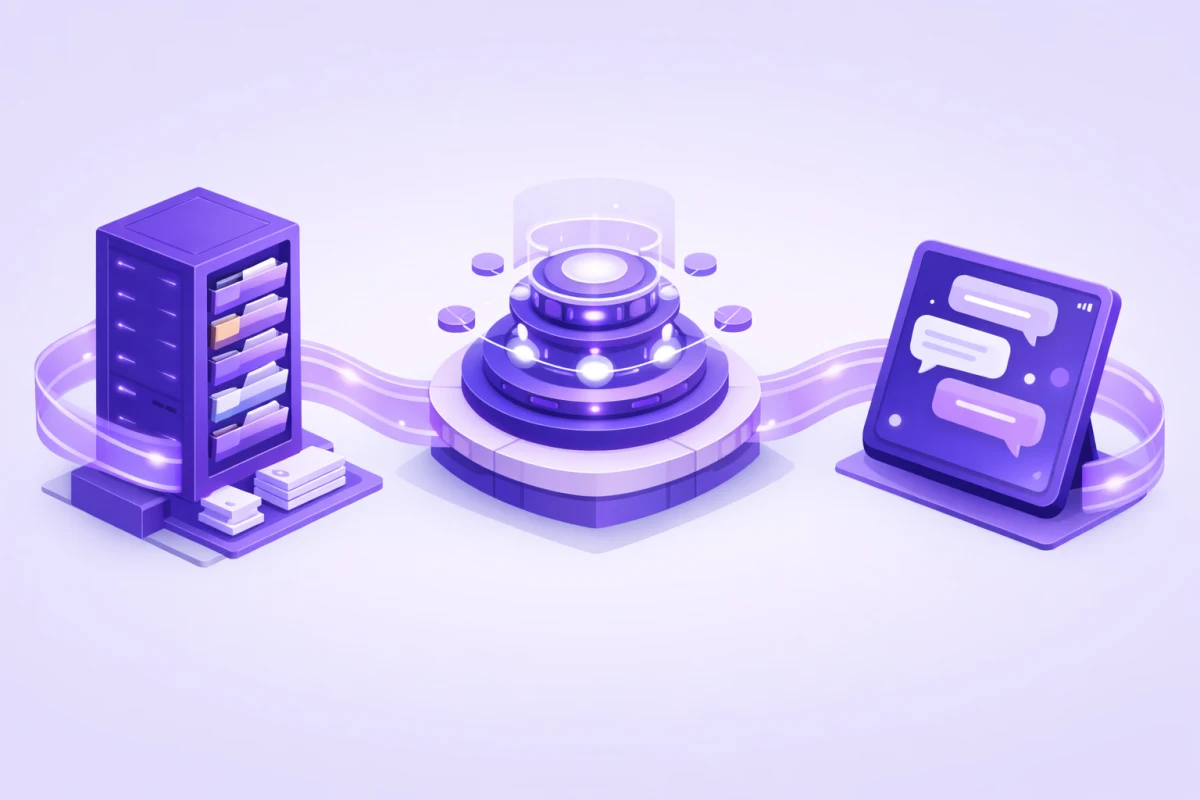
When a user asks a question, the RAG system first searches a connected database for relevant information. It then passes that information to the language model along with the original question. The model generates its response using this additional context, which typically results in more accurate, specific, and useful answers.
For a deeper dive into building these systems, check out our comprehensive RAG and vector database guide.
How Does RAG Work? The Three-Stage Process
Understanding how RAG works requires breaking down its three core stages: retrieval, augmentation, and generation. Let's walk through each one.
Stage 1: Retrieval
When you submit a query to a RAG system, it doesn't go straight to the language model. First, your question gets converted into a numerical representation called an embedding. This embedding captures the semantic meaning of your question.
The system then compares your query embedding against a database of pre-computed document embeddings. Using similarity calculations, it identifies which stored documents are most relevant to your question. The top matches get pulled for the next stage.
This retrieval step is powered by specialized vector databases designed for fast similarity searches across millions of embeddings. Understanding how AI embeddings capture meaning is crucial if you want to build effective RAG systems.
Stage 2: Augmentation
The retrieved documents don't just get dumped into the model. They're carefully combined with your original query to create an enriched prompt. This augmented prompt gives the language model specific context to draw from when generating its response.
Good prompt engineering matters here. The system needs to communicate clearly that the model should prioritize the retrieved information over its general training knowledge. Many RAG implementations include explicit instructions like "answer based only on the provided context."
Stage 3: Generation
Finally, the language model receives the augmented prompt and generates a response. Because it has relevant, specific information to work with, the output tends to be more accurate and grounded in facts.
The model can also cite its sources, pointing users to the specific documents that informed the answer. This traceability builds trust and lets people verify the information independently.
RAG Architecture Basics: The Core Components
To understand RAG architecture basics, you need to know the key components that work together. Every RAG system includes these elements.
The Knowledge Base: This is your external data repository. It could be company documentation, product manuals, research papers, customer support tickets, or any collection of information you want the AI to access. The quality of your knowledge base directly impacts output quality.
The Embedding Model: This component transforms text into numerical vectors. Both your stored documents and incoming queries get converted using the same embedding model. Popular options include models from OpenAI, Cohere, and open-source alternatives like Sentence Transformers.
The Vector Database: Vector databases store and index your document embeddings for efficient retrieval. They're optimized for similarity searches at scale. Leading options include Pinecone, Weaviate, Chroma, and Qdrant. For more context, read about understanding vector databases for RAG.
The Retriever: This component handles the similarity search. When a query comes in, the retriever finds the most relevant documents from the vector database. Some systems use hybrid approaches that combine vector search with traditional keyword matching.
The Generator: The large language model that produces the final output. This could be GPT-4o, Claude 3.5, Gemini 2.0, Llama 3, or any capable LLM. The generator synthesizes retrieved information into coherent, contextual responses.
The Integration Layer: This orchestrates the entire flow, coordinating between components and managing prompt construction. Frameworks like LangChain and LlamaIndex simplify building these pipelines.
Why RAG Matters: The Problem It Solves
Retrieval augmented generation explained in simple terms comes down to one core problem: language models make things up.
LLMs hallucinate. They generate confident-sounding responses that are completely wrong. This happens because they're trained to produce statistically likely text, not factually accurate text. When asked about something outside their training data, they often fabricate plausible-sounding answers.
For casual conversations, occasional errors might be acceptable. For business applications, they're not. A customer support bot that invents return policies or a medical assistant that generates fake treatment information creates serious problems.
RAG addresses this by grounding model outputs in retrieved evidence. When the AI has actual documents to reference, it's far less likely to hallucinate. And when it does make mistakes, the source citations make errors easier to catch.
The approach also solves the currency problem. Standard LLMs know nothing that happened after their training cutoff. A model trained in early 2024 can't tell you about events from late 2024 or 2025. RAG systems connected to regularly updated knowledge bases can provide current information without model retraining.
Learn more about this issue in our guide on AI hallucinations and how RAG helps.
RAG for Beginners: Getting Started
If you're new to this space, here's a simplified RAG for beginners breakdown of how to think about implementation.
Step 1: Prepare Your Data. Collect the documents you want the AI to access. This might be PDFs, web pages, database records, or plain text files. Clean and organize this content.
Step 2: Chunk Your Documents. Large documents need to be split into smaller pieces for effective retrieval. The chunking strategy matters. Too small, and you lose context. Too large, and you waste tokens and reduce precision. For guidance on this critical step, see splitting documents into retrievable chunks.
Step 3: Generate Embeddings. Run your chunks through an embedding model to create vector representations. Store these in a vector database along with references back to the original text.
Step 4: Build the Pipeline. Connect the components: query embedding, vector search, prompt construction, and generation. Test with sample queries and refine based on results.
Step 5: Iterate and Improve. Monitor performance. Track which queries fail and why. Update your knowledge base. Experiment with different retrieval parameters. RAG systems improve through continuous refinement.
The good news? You don't need to build everything from scratch. Platforms like AWS Bedrock, Google Vertex AI, and Azure AI provide managed RAG services. No-code tools make basic implementations accessible even without engineering expertise.
RAG vs. Fine-Tuning: Which Approach Should You Use?
One common question involves comparing RAG with fine-tuning approaches. Both customize LLM behavior, but they work differently and suit different needs.
Fine-tuning trains the model on additional data, adjusting its internal parameters. This bakes domain knowledge directly into the model's weights. The result is a specialized model that speaks your industry's language and understands your specific context.
RAG keeps the base model unchanged. Instead, it augments queries with retrieved information at runtime. The model's general capabilities stay intact while gaining access to external knowledge.
Use RAG when your information changes frequently and needs regular updates, when you need citations and source attribution, when data security requires keeping information outside the model, when you want to avoid expensive retraining, or when the base model already handles your domain's language reasonably well.
Use fine-tuning when you need the model to adopt a specific writing style or tone, when domain terminology is highly specialized and unfamiliar to general models, when response format consistency is critical, or when you're optimizing for inference speed without retrieval latency.
Many production systems combine both. A fine-tuned model handles specialized language and formatting while RAG provides access to current information.
Real-World RAG Use Cases
RAG isn't theoretical. Companies across industries are deploying it today.
Customer Support: DoorDash built a RAG-powered chatbot to help their delivery drivers. When a driver reports a problem, the system retrieves relevant help articles and past case resolutions, then generates a tailored response. The result? Faster resolution times and more accurate answers.
Enterprise Search: Thomson Reuters uses RAG to help customer support agents quickly find relevant information across vast internal knowledge bases. Agents can ask questions in natural language and get synthesized answers with source links.
Healthcare: Hospital systems integrate RAG with electronic health records and medical literature databases. Clinicians can query for treatment information relevant to specific patient conditions, with responses grounded in current research and institutional protocols.
Legal Research: Law firms apply RAG to search case law, contracts, and regulatory documents. Associates spend less time manually searching and more time on strategic analysis.
Education: Harvard Business School deployed an AI teaching assistant built on RAG. The system answers student questions about course materials, pulling from case studies, lecture notes, and historical class discussions.
If you're building AI-powered research assistants, RAG is likely part of your architecture.
Common RAG Challenges and How to Solve Them
RAG isn't magic. Implementation brings real challenges.
Retrieval Quality Issues: If the retriever doesn't find the right documents, the generator can't produce good answers. This happens when queries don't match document vocabulary, when relevant information is buried in large chunks, or when embeddings don't capture the right semantic relationships. Solutions include hybrid search combining vector and keyword approaches, improving RAG with reranking models, and careful attention to chunking strategies.
Context Window Limits: Even with retrieval, you can't pass unlimited text to the model. LLMs have context window limits and solutions matter here. When many documents get retrieved, the system must decide what fits and what gets cut. Solutions include smarter chunking, summarization of retrieved content, and strategic selection of the most relevant passages.
Latency: RAG adds steps to the response pipeline. Embedding the query, searching the vector database, and constructing the augmented prompt all take time. For real-time applications, this latency matters. Solutions include optimizing vector database performance, caching frequent queries, and using faster embedding models.
Data Quality: RAG systems are only as good as their knowledge bases. Outdated, inaccurate, or poorly organized documents lead to poor outputs. Solutions involve regular data maintenance, quality scoring for documents, and freshness tracking to prioritize recent information.
Residual Hallucination: RAG reduces hallucination but doesn't eliminate it. Models can still misinterpret retrieved content or fill gaps with fabricated details. Solutions include explicit instructions to acknowledge uncertainty, confidence scoring, and human review for high-stakes applications.
Advanced RAG Architectures
Basic RAG retrieves documents and generates responses. Advanced implementations add sophistication.
Agentic RAG gives the system autonomous capabilities. Instead of simple retrieval, an AI agent can plan multi-step queries, use tools, and iteratively refine its search strategy to answer complex questions.
Corrective RAG evaluates retrieved documents before generation. If the initial retrieval seems inadequate, it triggers additional searches or web lookups to improve context quality.
Self-RAG lets the model critique its own outputs. If a generated answer seems unsupported by retrieved evidence, it initiates new retrieval to strengthen the response.
Graph RAG uses knowledge graphs instead of flat document stores. This captures entity relationships and enables more sophisticated reasoning about connected concepts.
These advanced patterns address limitations of basic RAG but add implementation complexity. Start simple and add sophistication as your use case demands.
The Role of Large Language Models in RAG
RAG depends on capable large language models to process text and generate coherent responses. The generator component is typically a pretrained LLM like GPT-4o, Claude 3.5 Sonnet, Gemini 2.0 Flash, or Llama 3.
The model's general language capabilities determine baseline quality. Its ability to follow instructions affects how well it incorporates retrieved context. Its reasoning capacity influences how effectively it synthesizes multiple documents into coherent answers.
Choosing the right LLM involves tradeoffs. Larger models tend to produce higher quality outputs but cost more and run slower. Smaller models respond faster and cheaper but may struggle with complex queries or nuanced synthesis.
Many organizations start with commercial APIs like those from OpenAI or Anthropic, then explore open-source alternatives as they scale and seek more control.
Building Your First RAG System
Ready to browse AI tools and start building? Here's a practical path forward.
Start with a clear use case. Don't build RAG for its own sake. Identify a specific problem where access to external knowledge would improve AI responses. Customer support on product documentation? Internal search across company wikis? Legal contract analysis?
Assemble your knowledge base. Gather the documents you want the system to access. Clean and organize them. Think about what information users actually need and ensure it's represented in your data.
Choose your stack. Pick an embedding model, vector database, and LLM. If you're new, managed services reduce complexity. LangChain or LlamaIndex can simplify the orchestration layer.
Build a minimal prototype. Get something working end-to-end before optimizing. Test with real queries and see where it fails.
Iterate based on failures. RAG systems improve through careful attention to what goes wrong. Track bad outputs, diagnose root causes, and fix systematically.
Monitor in production. RAG performance can degrade as knowledge bases grow stale or query patterns shift. Build in observability from the start.
The Future of RAG
RAG adoption is accelerating. Recent surveys show over 60% of organizations developing AI-powered retrieval tools. Market projections estimate growth from $1.2 billion in 2024 to over $11 billion by 2030.
Several trends are shaping RAG's evolution:
Multimodal RAG extends beyond text to retrieve and reason over images, audio, and video. Imagine asking about a product and getting responses informed by both documentation and instructional videos.
Streaming RAG handles real-time data feeds, keeping knowledge bases current with minimal latency. This matters for applications where information changes rapidly.
Better evaluation frameworks help teams measure RAG performance systematically. As the field matures, standardized benchmarks and automated testing become more important.
Tighter enterprise integration connects RAG to the systems where work happens. Native connectors to Salesforce, Confluence, SharePoint, and other platforms reduce the friction of building knowledge bases.
The trajectory is clear. RAG is becoming standard infrastructure for enterprise AI, not an experimental technique.