What Is Agentic RAG?
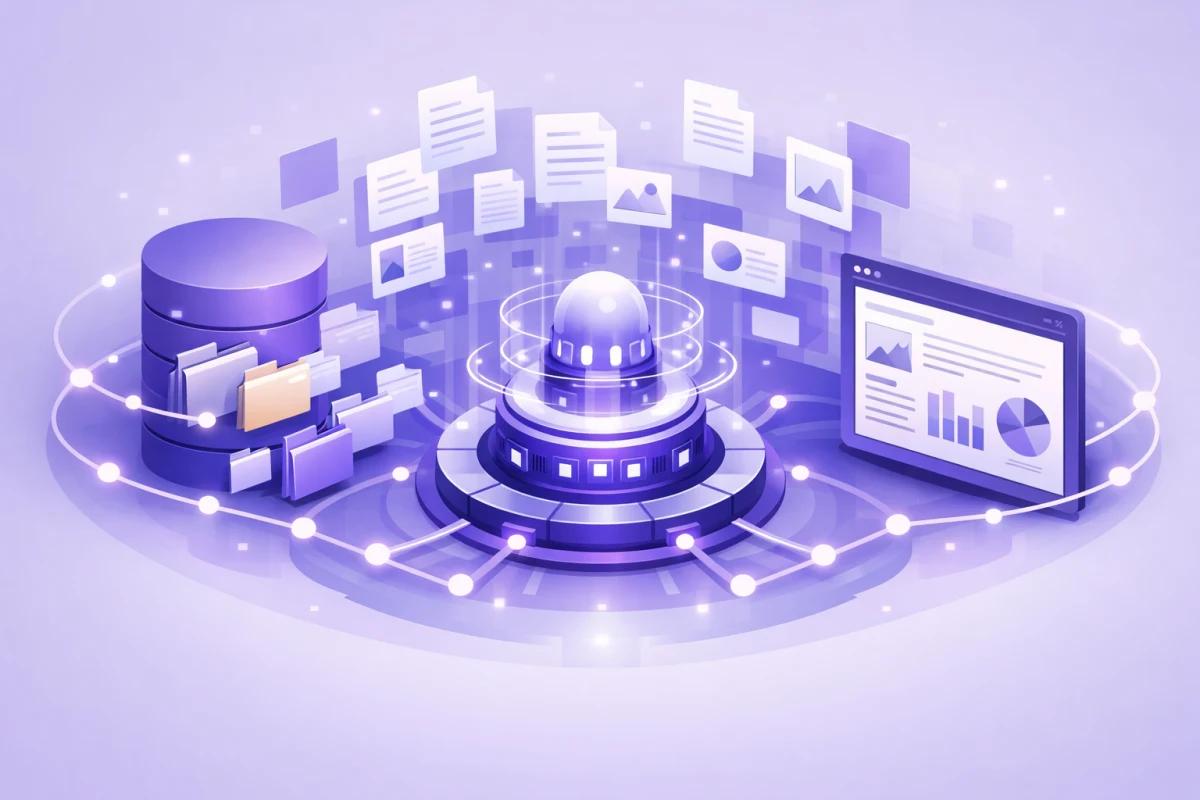
Agentic RAG integrates autonomous AI agents directly into the retrieval augmented generation pipeline. Instead of following a rigid sequence of retrieve-then-generate, these systems reason through the retrieval process itself.
Think about what happens when you ask a complex question to a standard RAG system. It converts your query to a vector, searches a database, pulls the top results, and generates an answer. One shot. No adaptation. No validation.
Agentic RAG does something different. The agent first evaluates whether retrieval is even necessary. Then it decides which sources to query. After retrieving information, it assesses whether those results actually answer the question. If not, it reformulates the query and tries again.
This creates an intelligent retrieval loop rather than a fixed pipeline.
Understanding retrieval augmented generation basics helps appreciate why this evolution matters. Traditional RAG solved the hallucination problem by grounding LLM responses in external data. But it created new problems around relevance, context management, and handling complex queries that require information from multiple sources.
Why Traditional RAG Falls Short
Standard RAG systems have several limitations that become obvious in production:
Single-shot retrieval. The system retrieves context once based on the original query. If that retrieval misses relevant information, the generated answer suffers.
No query understanding. Traditional RAG treats every query the same way. A simple factual question gets the same retrieval process as a complex multi-part analysis request.
No result validation. Once documents are retrieved, they go straight to the LLM. There's no mechanism to evaluate whether those documents actually contain useful information.
Limited source routing. Basic RAG typically queries one knowledge base. Real-world questions often need information scattered across multiple systems, databases, and external APIs.
These constraints make traditional RAG brittle. It works well for straightforward questions against clean datasets. It struggles with ambiguous queries, multi-hop reasoning, and scenarios where the answer isn't contained in a single document chunk.
The Four Agentic Patterns
Researchers have identified four core design patterns that give agentic RAG systems their intelligence. These patterns can be used individually or combined for more sophisticated workflows.
Reflection
Reflection enables agents to evaluate and refine their own outputs. After generating an initial response or completing a retrieval step, the agent critiques its work. It asks: Is this information relevant? Is this response accurate? What did I miss?
This self-assessment creates an iterative improvement loop. The agent identifies errors, gaps, or inconsistencies and takes corrective action before delivering a final answer.
In practice, reflection dramatically improves accuracy for tasks like code generation, summarization, and question answering. Self-RAG systems use reflection tokens to continuously assess output quality throughout the generation process.
Planning
Planning allows agents to decompose complex queries into manageable subtasks. Rather than attempting to answer everything at once, the agent creates a structured workflow.
Consider a question like "Compare our Q3 performance against industry benchmarks and identify areas for improvement." A planning agent might break this into: retrieve Q3 data, search for industry reports, analyze the comparison, and synthesize recommendations.
This pattern proves essential for planning and reasoning in agents that handle multi-step workflows. The agent dynamically adjusts its plan based on what it discovers at each step.
Tool Use
Agents need to interact with the world beyond text generation. Tool use expands their capabilities to include vector search engines, web search, calculators, APIs, databases, and specialized software.
A financial analysis agent might use a vector database to retrieve company filings, a calculator to compute ratios, and a charting tool to visualize trends. Each tool serves a specific purpose in the agent's workflow.
Tool use and function calling has become a foundational capability in modern AI systems. Agentic RAG relies heavily on this pattern to access diverse information sources and perform computations.
Multi-Agent Collaboration
Some tasks benefit from multiple specialized agents working together. One agent might handle retrieval while another focuses on reasoning. A third might validate outputs for accuracy.
This division of labor mirrors how human teams operate. Each agent contributes its expertise, and a coordinator manages the overall workflow.
Multi-agent systems enable sophisticated capabilities like parallel retrieval from different sources, cross-validation of information, and specialized processing for different data types.
Agentic RAG Architectures
The complexity of agentic RAG systems varies based on requirements. Here are the main architectural patterns.
Single-Agent Router
The simplest form of agentic RAG adds routing capability to a standard pipeline. The agent decides which of several knowledge sources to query based on the question type.
A support chatbot might route product questions to a documentation database and billing questions to an account system. This basic routing already improves over monolithic RAG systems.
Self-Correcting RAG
Corrective RAG (CRAG) introduces a validation loop. After retrieval, an evaluation agent assesses document relevance. If retrieved information scores below a threshold, the system reformulates the query or searches alternative sources.
The corrective architecture typically includes five agents working together: context retrieval, relevance evaluation, query refinement, external knowledge retrieval, and response synthesis. This ensures high accuracy by dynamically correcting retrieval errors.
Adaptive RAG
Adaptive RAG adjusts its approach based on query complexity. Simple factual questions skip directly to retrieval. Moderately complex queries use standard RAG with one retrieval step. Highly complex queries trigger multi-step retrieval with intermediate reasoning.
A classifier analyzes incoming queries and routes them appropriately. This prevents over-engineering simple requests while ensuring complex questions get proper treatment.
Hierarchical Multi-Agent RAG
For enterprise-scale applications, hierarchical architectures coordinate multiple specialized agents. A master agent receives queries and delegates to subordinate agents based on domain.
One agent might specialize in legal documents. Another handles financial data. A third manages product information. The master agent aggregates results and synthesizes a coherent response.
This approach scales well because individual agents can be optimized for their specific domains without complicating the overall system.
How Autonomous Retrieval Works
Autonomous retrieval represents the core innovation in agentic RAG. Instead of passive document fetching, the agent actively reasons about what information it needs.
The process typically follows this pattern:
Query analysis. The agent examines the incoming question to understand intent, identify required information types, and detect potential ambiguities.
Retrieval decision. Based on analysis, the agent determines whether retrieval is necessary. Some questions can be answered from context or the LLM's knowledge. Others require external data.
Source selection. The agent identifies which knowledge sources to query. This might include vector databases, graph databases, web search, or internal APIs.
Query formulation. Rather than using the raw user question, the agent generates optimized search queries for each source. Self-querying RAG systems can automatically rewrite queries to improve retrieval precision.
Retrieval execution. The agent queries selected sources, potentially in parallel to reduce latency.
Result validation. Retrieved documents are evaluated for relevance. Irrelevant results are filtered. If insufficient relevant content is found, the agent may requery with modified parameters.
Context synthesis. Relevant information is combined and potentially summarized before being passed to generation.
This intelligent retrieval process produces higher-quality context than static pipelines. The agent adapts to each query's specific needs rather than applying a one-size-fits-all approach.
Self-Querying Capabilities
Self-querying RAG takes autonomous retrieval further by enabling agents to generate and refine their own search queries. This addresses a persistent RAG challenge: user queries often don't translate directly into effective database searches.
Someone asking "What did we decide about that marketing campaign?" provides vague input. A self-querying agent can recognize this ambiguity and generate more specific queries: "marketing campaign decisions Q4" or "approved marketing budget items."
The agent maintains a feedback loop. If initial queries return poor results, it automatically adjusts. It might narrow scope, broaden search terms, or query different metadata fields.
This capability proves especially valuable for building enterprise knowledge bases where users may not know exactly how information is organized or labeled.
Integration with Knowledge Graphs
Knowledge graphs enhance RAG systems by capturing relationships between entities. Agentic RAG can leverage these structures for more sophisticated reasoning.
Graph-based agentic RAG systems use relationship traversal to answer multi-hop questions. "Who manages the team that developed our top-selling product?" requires following connections: product to team to manager.
Agents can query both vector stores for semantic similarity and knowledge graphs for structured relationships. This hybrid approach combines the flexibility of embeddings with the precision of explicit knowledge representation.
Frameworks for Building Agentic RAG
Several frameworks have emerged to support agentic RAG development. Each offers different tradeoffs between simplicity and capability.
LlamaIndex started as a RAG framework and evolved into a comprehensive agent platform. Its AgentWorkflow system handles multi-agent orchestration, memory management, and tool integration. The framework excels at document-centric applications and provides strong RAG building blocks.
LangGraph from LangChain enables graph-based workflow definition. Developers define nodes (agents, tools, functions) and edges (transitions, conditions) to create complex reasoning flows. The visual approach makes sophisticated workflows more manageable.
CrewAI focuses on multi-agent collaboration. It uses a role-based metaphor where agents have backstories, goals, and tools. Multiple agents work together on tasks, passing information and building on each other's work.
AutoGen from Microsoft enables research-style multi-agent experiments. Agents can engage in conversations, delegate tasks, and collaborate flexibly on complex problems.
Choosing the right framework depends on your use case. For RAG-heavy applications, LlamaIndex offers the most relevant primitives. For complex workflows with conditional logic, LangGraph provides clearer structure. For multi-agent collaboration, CrewAI simplifies team-based architectures.
If you're exploring AI agent builder platforms, look for ones that support tool integration, memory persistence, and flexible orchestration patterns.
RAG with Agents in Practice
Understanding AI agents helps contextualize how agentic RAG fits into broader AI systems. Agents provide the autonomy, RAG provides the knowledge grounding.
Consider a legal research application. Traditional RAG might search case law based on keywords and return relevant passages. An agentic system does more.
First, it analyzes the research question to identify relevant legal concepts, jurisdictions, and time periods. Then it formulates targeted queries for different databases: case law, statutes, regulations, secondary sources.
As it retrieves documents, it evaluates relevance and authority. A recent Supreme Court decision carries more weight than a decades-old district court ruling. The agent factors this into its synthesis.
If initial results seem insufficient, it broadens the search or queries related concepts. It might recognize that a seemingly irrelevant case actually contains important dicta on the issue at hand.
The final output isn't just a list of cases. It's a structured analysis with citations, organized by relevance and authority.
This kind of sophisticated research workflow requires agent orchestration strategies that coordinate multiple retrieval steps, validation checks, and synthesis operations.
Understanding Agentic AI Systems
The shift toward agentic systems reflects broader trends in AI architecture. What makes AI systems agentic goes beyond adding retrieval capabilities. It involves fundamental changes in how AI systems perceive, reason, and act.
Agentic RAG sits at the intersection of retrieval systems and autonomous agents. It inherits RAG's knowledge grounding while gaining agent capabilities for planning, reasoning, and adaptation.
This combination proves powerful for enterprise applications where accuracy matters and queries can be complex. Static pipelines can't adapt to edge cases. Agentic systems can.
Ready to explore tools for building intelligent AI systems? Browse our AI tools directory to discover platforms that support agentic workflows and RAG implementations.
Enterprise Applications
Agentic RAG is finding traction across industries where knowledge work dominates.
Legal and compliance. Law firms use agentic systems for contract analysis, case research, and compliance verification. The systems can reason across multiple documents, identify relevant precedents, and flag potential issues.
Healthcare. Medical research applications use agentic RAG to analyze patient records, research literature, and clinical guidelines. Multi-agent systems can correlate symptoms with diagnoses while validating against current medical knowledge.
Financial services. Investment research, risk analysis, and regulatory reporting benefit from systems that can aggregate information from diverse sources and reason about complex financial scenarios.
Customer support. Enterprise support systems use agentic RAG to handle complex queries that span multiple products, policies, and technical domains. The agent can retrieve from knowledge bases, check account status, and reason about solutions.
DevOps and IT. Log analysis systems use self-correcting RAG to diagnose issues across distributed systems. Multiple agents can specialize in different components while coordinating on root cause analysis.
Building Agent Retrieval Systems
Implementing agentic RAG requires thinking differently about system design. Here are key considerations.
Start with clear use cases. Not every application needs full agentic capabilities. Simple Q&A against a clean knowledge base might work fine with traditional RAG. Reserve agentic complexity for scenarios involving multi-source retrieval, complex reasoning, or iterative refinement.
Design your agent loop carefully. Agentic systems can get stuck in infinite loops or waste resources on unnecessary iterations. Build in termination conditions, maximum iteration limits, and cost monitoring.
Invest in evaluation. Testing agentic systems is harder than testing static pipelines. You need to evaluate not just final outputs but intermediate decisions. Did the agent choose the right sources? Did it correctly identify when to requery?
Plan for observability. Debugging agentic systems requires visibility into agent decisions, retrieval steps, and reasoning chains. Implement logging and tracing from the start.
Consider latency tradeoffs. Multiple retrieval steps and validation checks add latency. For real-time applications, you may need to balance thoroughness against response time.
Challenges and Limitations
Agentic RAG isn't a universal solution. It introduces new complexities alongside its benefits.
Increased latency. Multiple retrieval steps, validation checks, and potential retries take time. Simple queries that traditional RAG handles instantly may take several seconds in agentic systems.
Higher costs. More LLM calls for planning, evaluation, and synthesis means higher API costs. Complex multi-agent systems can be expensive to operate at scale.
Debugging difficulty. When an agentic system produces a wrong answer, tracing the cause requires examining multiple decision points. Was the query planning wrong? Did retrieval fail? Did validation miss something?
Reliability concerns. Agent reasoning can be unpredictable. The same question might trigger different retrieval strategies on different runs, potentially producing inconsistent results.
Scaling challenges. Multi-agent systems with shared memory and complex coordination can be difficult to scale horizontally. Careful architecture is required for high-throughput applications.
The Future of Intelligent Retrieval
Agentic RAG represents the current frontier in knowledge-grounded AI systems. But the field continues evolving rapidly.
Reasoning models. New LLMs with enhanced reasoning capabilities, like those using chain-of-thought training, make agentic patterns more reliable. Better reasoning means better retrieval decisions and higher-quality synthesis.
Multimodal retrieval. Future systems will retrieve and reason across text, images, audio, and video. An agent might analyze a financial report's text alongside its charts and graphs.
Learned retrieval policies. Reinforcement learning is being applied to train agents on optimal retrieval strategies. Rather than hand-coded logic, systems learn when and how to retrieve based on outcome feedback.
Hybrid architectures. The distinction between RAG and agent systems is blurring. Future architectures will likely integrate retrieval, reasoning, and action more tightly, with less rigid separation between components.
Getting Started
If you're building AI applications that require external knowledge, consider whether agentic RAG fits your needs. For simple retrieval scenarios, start with RAG fundamentals before adding agent complexity.
For complex enterprise applications involving multiple knowledge sources, iterative reasoning, or high accuracy requirements, agentic RAG offers substantial benefits over static pipelines. The additional complexity pays off in better handling of edge cases and ambiguous queries.
The frameworks exist. The patterns are documented. The main challenge is matching the right level of agentic sophistication to your specific use case.