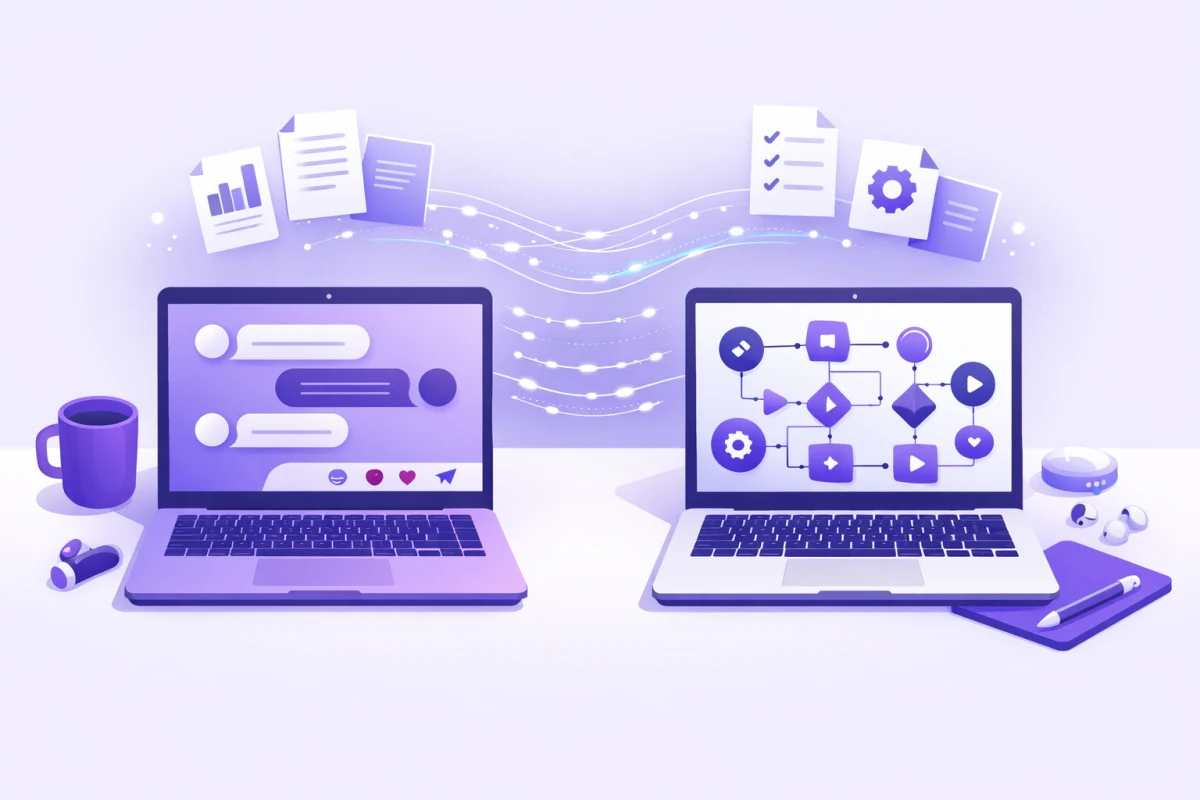
What's the Real Difference Between AI Assistants and Agents?
The AI assistant vs agent debate isn't just semantics. These terms describe fundamentally different approaches to how AI systems help you work.
Think of it this way: an AI assistant is like a skilled secretary who waits for instructions, handles tasks you assign, and gives recommendations. An AI agent is more like a business partner who proactively identifies opportunities, makes decisions, and executes plans without constant supervision.
IBM describes it well: AI assistants are reactive, performing tasks at your request. AI agents are proactive, working autonomously to achieve specific goals by any means at their disposal.
This distinction matters because choosing the wrong type of AI for your workflow leads to frustration, wasted resources, or missed opportunities. Understanding autonomous AI systems helps you match the right tool to your actual needs.
How AI Assistants Actually Work
AI assistants have been around longer than most people realize. Siri launched in 2011. Alexa followed in 2014. These early versions relied on rule-based instructions and predefined responses. Today's assistants are almost entirely powered by large language models (LLMs), making them dramatically more capable.
Modern AI assistants like ChatGPT, Claude, and Google Gemini use natural language processing to understand your questions and provide helpful responses. They excel at:
Conversational interactions. You ask a question, they answer. You request a draft, they write it. The assistant waits for you to serve first, then responds.
Task support within clear boundaries. Setting reminders, scheduling meetings, sending messages, summarizing documents, answering research questions. Assistants handle discrete tasks you define.
Augmenting human decision-making. Rather than deciding for you, assistants surface information, suggest options, and help you think through problems. The final call remains yours.
The key limitation? Assistants don't take initiative. They need prompts for every action. Like a tennis match where the assistant never serves first, you must keep the conversation moving.
For many AI-powered personal assistants, this reactive design is actually a feature, not a bug. You stay in complete control while getting productivity boosts for routine work.
How AI Agents Operate Differently
AI agents represent a significant shift in how AI systems function. Give an agent a goal, and it figures out how to achieve it with minimal ongoing input from you.
The agent vs assistant difference becomes clear when you look at what agents can do independently:
Autonomous planning. Instead of waiting for step-by-step instructions, agents reason about what steps are needed to accomplish a goal. They break complex objectives into manageable tasks and sequence them appropriately.
Tool use and system integration. Agents can access external databases, call APIs, interact with software, and coordinate across multiple systems. They don't just suggest actions; they execute them.
Adaptive decision-making. When conditions change or unexpected issues arise, agents adjust their approach. They learn from outcomes and refine their strategies over time.
Goal persistence. Unlike assistants that respond to individual prompts, agents maintain focus on objectives across extended interactions. They track progress, identify blockers, and work toward completion.
According to AWS research, agentic AI capabilities exist on a spectrum with four levels:
Level 1 systems follow specific rules with human input (like chatbots). Level 2 adds reasoning to select and execute predefined actions. Level 3 can dynamically plan, execute, and iterate on complex tasks with minimal supervision. Level 4 operates with little oversight across domains, proactively setting goals and adapting.
Most enterprise deployments in 2025 and 2026 sit at Level 1 and 2, with some exploring Level 3 for specific applications. For a deeper look at the spectrum of AI autonomy levels, understanding where different tools fall helps you set realistic expectations.
Copilot vs Agent: Where Do Copilots Fit?
The copilot vs agent distinction confuses many people because copilots combine elements of both approaches.
An AI copilot is a collaborative tool designed to work alongside you, enhancing productivity while keeping you in the driver's seat. Microsoft's definition captures it well: copilots are AI-powered assistants that provide real-time support, suggestions, and contextual guidance.
The name says it all. A copilot sits next to you, offering help as you navigate. You make the decisions; the copilot makes execution smoother.
Key copilot characteristics:
Context sensitivity. Copilots adapt to your environment. GitHub Copilot suggests code relevant to what you're currently building. Salesforce Einstein Copilot pulls up customer data relevant to your current conversation.
Real-time assistance. Instead of batch processing or background operation, copilots provide feedback as you work. They catch errors before they become problems.
Human-centric design. The goal is augmentation, not automation. Copilots assume you have expertise and judgment; they accelerate your existing capabilities.
Where agents and copilots diverge is autonomy. Microsoft frames agents as specialized tools that can respond to and resolve user inquiries in real time, or operate independently, taking specific actions based on data and predefined goals. Agents can run entire business processes. Copilots help you run them.
If agents are apps that do work, copilots are the interface you use to interact with those agents. Some platforms, like Microsoft 365 Copilot, actually feature constellations of specialized agents that users access through the copilot interface.
For teams evaluating their options, comparing assistants, agents, and copilots side by side clarifies which approach fits specific use cases.
The Autonomy Spectrum: From Chatbots to Agents
Rather than thinking about assistants and agents as binary categories, it helps to visualize a spectrum of AI autonomy.
At one end: traditional chatbots. These follow predefined scripts and struggle when users stray from expected conversation paths. They're rule-based, rigid, and limited to narrow tasks.
Next come AI assistants. Powered by LLMs, they understand natural language and can handle much broader queries. But they remain reactive, requiring user prompts for every action.
Copilots add collaboration. They proactively offer suggestions and surface relevant information, but humans approve all actions and maintain control.
Agentic systems operate with significant autonomy. They plan multi-step workflows, execute actions across systems, and adapt based on outcomes. Humans set goals and boundaries; agents figure out the rest.
The difference between chatbots versus agent systems isn't just capability. It's a fundamental shift in how AI participates in work.
Gartner predicts 40% of enterprise applications will include task-specific AI agents by the end of 2026, up from less than 5% in 2025. This rapid growth reflects businesses recognizing that many workflows benefit from AI that can act, not just advise.
When to Use Agent vs Assistant: Practical Decision Framework
The question of when to use agent vs assistant depends on several factors. Here's a practical framework for deciding:
Choose an AI assistant when:
You need quick, simple task help. Looking up information, drafting an email, summarizing a document. Tasks that take minutes, not hours.
You want to stay in complete control. High-stakes decisions where human judgment is essential. Situations where errors carry significant consequences.
The task varies significantly each time. Creative work, strategic planning, nuanced communication. Areas where standardization would hurt quality.
You're supporting conversational interactions. Customer service queries with human handoff. Support scenarios where empathy and flexibility matter.
Choose an AI agent when:
You need goal-driven, end-to-end automation. Entire workflows that follow predictable patterns. Processes spanning multiple systems and handoffs.
The task is repetitive and scalable. Invoice processing, lead qualification, data entry. High-volume work that's too manual for humans to handle efficiently.
Real-time decision-making matters. Fraud detection, dynamic pricing, network optimization. Situations where speed exceeds human reaction time.
Cross-departmental coordination creates bottlenecks. Onboarding workflows involving IT, HR, and facilities. Processes where manual handoffs add delays.
The middle ground: use human-in-the-loop agent systems for complex tasks requiring both AI execution and human oversight. These hybrid approaches let agents handle routine work while escalating exceptions to humans.
For teams exploring different approaches, understanding the various categories of agents helps identify which type matches specific business needs.
Real Examples: Assistants and Agents in Action
Abstract definitions only go so far. Here's how assistants and agents differ in practical applications:
Customer Support
Assistant approach: A support agent uses Claude to draft responses to customer inquiries. They paste the customer's message, get a suggested reply, review it, adjust the tone, and send. The assistant makes the human faster, but the human drives every interaction.
Agent approach: An AI agent monitors incoming support tickets, classifies them by urgency and type, routes them appropriately, handles routine requests autonomously (password resets, order status updates), and escalates complex issues to human agents with relevant context already summarized. The agent runs the workflow; humans handle exceptions.
Sales Operations
Assistant approach: A sales rep asks an AI assistant to research a prospect before a call. The assistant pulls relevant information from available sources and provides a summary. The rep decides how to use it.
Agent approach: An AI agent continuously monitors the CRM, identifies leads matching qualification criteria, sends personalized outreach emails, tracks responses, schedules follow-up sequences, and books meetings with prospects who engage. Human sales reps focus on conversations, not prospecting.
Software Development
Assistant approach: A developer uses an AI coding assistant like GitHub Copilot to autocomplete functions, suggest implementations, and catch bugs. The developer reviews every suggestion and makes final decisions.
Agent approach: An autonomous coding agent takes a natural language goal, generates code, writes tests, runs them, analyzes failures, and iterates until tests pass. Platforms like Devin AI demonstrate this shift from assisted coding to automated development workflows.
Financial Operations
Assistant approach: A finance analyst asks an AI assistant to explain a complex regulation or help interpret data in a spreadsheet. The assistant provides information; the analyst applies judgment.
Agent approach: An AI agent performs continuous risk audits, monitors for unusual patterns, flags potential compliance issues, generates reports, and escalates findings that require human review. The agent handles volume and pattern recognition; humans handle judgment calls.
These examples illustrate why understanding agentic AI beyond chatbots matters for operational planning. The right choice depends on whether you need help or delegation.
The Human-in-the-Loop Question
One critical consideration when evaluating agents: how much autonomy is appropriate?
The industry is moving from Human-in-the-Loop (HITL), where humans approve every action, to Human-on-the-Loop (HOTL), where humans monitor operations and intervene only for exceptions.
This shift requires careful thought. As systems become more autonomous, the quality of human oversight becomes more critical even as the quantity decreases. When an agent handles 99% of tasks, the remaining 1% are by definition the most complex and high-stakes.
Google's VP for Southeast Asia put it directly: You wouldn't want to have a system that can do this fully without a human in the loop.
For high-risk applications like healthcare, finance, or safety-critical systems, agent designs should include:
Approval gates before irreversible actions. Let agents prepare and recommend, but require human sign-off for decisions with significant consequences.
Confidence thresholds that trigger escalation. When agent certainty falls below defined levels, route to human review.
Audit trails documenting agent reasoning. Understanding why an agent made a decision is essential for accountability and improvement.
Clear boundaries on agent authority. Define what agents should never do and build these limits into the system from day one.
McKinsey research shows enterprises implementing HITL report 30 to 35% productivity gains while maintaining accuracy levels that exceed traditional human-only operations. The goal isn't maximum autonomy; it's optimal autonomy for the specific context.
Building Your AI Strategy: Assistants, Agents, or Both?
Most organizations won't choose exclusively between assistants and agents. The practical question is how to deploy each where it fits best.
Start with high-impact, well-defined use cases. Agent implementations succeed when they target specific workflows with clear inputs, predictable steps, and measurable outputs. Trying to build general-purpose agents typically fails.
Match agent capability to organizational readiness. Gartner positions AI agent adoption as part of a multi-year transformation journey. Organizations are currently in an early pilot phase (2025 to 2027), with mainstream adoption expected by 2027 to 2029. Don't outpace your infrastructure, governance, or change management capacity.
Invest in data quality. Agents are only as reliable as the data they access. Garbage in, garbage out applies forcefully to autonomous systems.
Design for observation. Monitor not just what agents accomplish, but how they accomplish it. The path matters as much as the destination.
Plan for the assistants to agents transition. Many organizations start with AI assistants embedded in applications, then evolve toward more autonomous agent capabilities as confidence and infrastructure mature.
For those ready to explore agent platforms, discovering AI agent tools reveals the range of options from open-source frameworks to enterprise solutions.
What's Coming Next: 2026 and Beyond
Several trends are shaping the evolution of AI assistants and agents:
Multi-agent systems. Instead of single all-purpose agents, teams of specialized agents collaborate on complex problems. A planner agent coordinates with execution agents, review agents, and human-in-the-loop supervisors.
Better reasoning capabilities. Foundation models continue improving at multi-step reasoning, making agents more reliable for complex tasks. Reduced hallucination rates and better factual grounding increase trust.
Standardized tool integration. Protocols like Anthropic's Model Context Protocol (MCP) are emerging as standards for connecting agents to external systems. This reduces integration friction and accelerates deployment.
Governance frameworks. As agents make more decisions autonomously, auditability, explainability, and ethics become foundational requirements. The EU AI Act mandates human oversight for high-risk AI systems.
Blended human-AI teams. By 2028, research suggests 38% of organizations will have AI agents as team members within human teams. The question isn't replacement; it's collaboration design.
For anyone building knowledge in this space, a complete guide to AI agents provides deeper technical and strategic context.
How to Choose the Right AI Solution for Your Needs
Making the right choice between assistants, copilots, and agents requires honest assessment of your situation:
Evaluate task complexity. Simple, variable tasks that need human judgment favor assistants. Complex, predictable, high-volume tasks favor agents.
Consider error tolerance. How much does a mistake cost? Low tolerance for errors suggests keeping humans in the loop. High-volume, lower-stakes work can tolerate more autonomy.
Assess existing systems. Agents that need to coordinate across multiple enterprise systems require integration infrastructure. If your systems aren't ready, start with assistants while building that foundation.
Factor in change management. Adopting autonomous agents changes workflows and job descriptions. Organizations need time to adapt processes and develop new oversight skills.
Start small, prove value, scale. Pilot with defined scope. Measure results. Expand based on demonstrated ROI, not theoretical potential.
Need help selecting the best agent for your specific requirements? Framework selection guides help narrow options based on technical requirements and business context.
Ready to find tools that match your workflow? Browse the AI agents marketplace to explore options across categories, compare features, and see what other teams are using.
Final Thoughts
The AI assistant vs agent distinction isn't about which is better. It's about which is right for the task at hand.
Assistants excel when you want AI to amplify human capabilities while keeping you in control. They're reliable, predictable, and immediately useful for a wide range of productivity needs.
Agents shine when you need AI to own entire workflows, make autonomous decisions, and operate at scales that would overwhelm human workers.
Copilots bridge the gap, offering collaborative intelligence without full autonomy.
Most organizations will deploy all three, matching capability to context. The winners won't be those who adopt the most advanced AI, but those who deploy the right AI for each specific challenge.